Monday, August 16, 2010

“You're going to Hell.... Not.” I'm Catholic, not Puritan. Thank you.

[This is an article on what the Catholic Church believes, to the best of my knowledge. If you disagree with the tenants of the faith spelled out, if you dislike what they say, dislike what the Church says, disagree with the qualifications of what is or is not a sin, or if you do not believe that there is a God period … okay, that's cool. I'm not trying to convince you of any of the above, just trying to give you Catholic positions in layman's terms. Thank you. The disclaimer ends.]

I enjoy having other people tell me what I believe. It's amusing.

Recently, I was told that “hardcore Catholics think everybody's going to Hell.”

Hi, um, no.

Granted, my “hardcore” status involves going to Church on Sundays and Holy days, and knowing more about Catholic philosophy than the average bear. Aside from that... meh, not really.

But, for the record, unlike Dante Alighieri in The Inferno, the Catholic Church has never pointed to any person and said “He's in Hell.” The strongest the Church has done to anybody has been excommunication— which is a societal pressure, mainly used to get someone's attention, and requires that the penitent have done something REALLY messed up. The Church of Rome believes that it represents God, NOT that is IS God. No one knows what is in another's heart, head, or conscience.

And there's the usual anti-sex, anti-gay mythology.

1) No one is going to hell for BEING gay. A sin is an ACTION, not a state of being. You have to DO something. Nathan Lane has stated that he his gay, Catholic, and celibate.... but on the other hand, he could barbeque puppies for fun. On the other end of the spectrum, if anybody (gay, straight, male, female) is having sex with large amounts of people per month, I have several, non-religious things to say to them – and my mother's a microbiologist, I can footnote everything. One of the major concerns I have I share with most of the priests I meet, gay author Harvey Fierstein, and lesbian/former NOW President (LA) Tammy Bruce: promiscuous activity, which really isn't a gay/straight male/female problem, it's pretty much everyone. And many of my arguments come from one place-- the microbiology lab.

2) Sex. Ask at the Vatican, getting a (non-medical) abortion is a sin. So is using a condom, and so is (PREMARITAL) sex. Are any and all of those people automatically going to hell? Take Angelina Jolie: when she was fourteen, with a boyfriend, her own mother told her to take the master bedroom and “have fun, it's better than the back of a car.” I am hard-pressed to imagine anyone condemning her behavior at fourteen, and given what (very little) I've heard, I think it would be more reasonable to think “Wow, I'm surprised she's not REALLY screwed up.”

Do I believe that sodomy, premarital sex, condom usage, abortion, et al are sins? Yes, and I think that most of them are bad ideas independently of religion, mostly based on psychological, sociological reasons, and personal observation. But that's another story. Am I going to Judge those people who partake / have partaken of those acts and say they're going to Hell? No, no, no, and Hell no.

I think a lot of this can be covered under “conscience”-- con (with) (science) knowledge... There is something called “invincible ignorance,” something doesn't register on the conscience, for whatever reason. I naturally assume that (for example) teenagers are too stupid to know right from left, to hell with knowing right from wrong. which means that, yes, one can be too stupid to know one is doing something wrong. Now, who knows what evil lurks (or doesn't) in the hearts of men (and women) ....

God does.

No one else.

Have a nice day.

To make my point, I will use a personal example. I'm Celibate. An ex of mine slipped me a drug for the purposes of having me sleep with her. Am I going to say she's going to Hell? I can't say that one way or another, mainly because I know how utterly and totally screwed up she is. Looking at it from the distance of time, she's a LOT more than “standard” crazy, and I should have seen it coming. I can't say she's evil, because I know that she is lonely, believes that if someone (non related) isn't sleeping with her, they don't love her, and she's really screwed up in the head. I don't know what she was thinking at the time, since I wasn't going to have an extended conversation about it.

A lot of the misconception about the Catholic Church comes from the line “Outside the Church there is no salvation.” It's a phrase that people like to throw around a lot. However, if you talk to any cannon lawyer, you know there's a caveat to practically anything. “The Church” is defined as the “mystical body of Christ”.... take out the fancy language, the Church is God. God covers a LOT of territory. If you look up the phrase “Baptism of Desire,” even Wikipedia comes close: it comes about with an “act of perfect love and contrition which automatically cleanses the soul of all sin.” There is also the “baptism of blood;” Protestants have been accepted as Catholic saints and martyrs because they were “died for Christ.”

So, yes, the Catholic Church put in a loophole. A few loopholes. “Outside the church there is no salvation”... but. I know a few atheists, some who are probably better people than I am. Oddly, I think one was a better Catholic than I am.

Oh, and as several Popes have mentioned over the years, Jews are “inside the Church” because God does not renege on His deals ... we are not Fred Phelps and his incestuous, attention-seeking media-whore cult.

However, I have heard stories. “Catholics” who are holier than that, and think Protestants should be burned at the stakes for heresy, but that they, themselves, have never read the bible, “That's what the priest is for.”

Statements like that want to make me find these people and drop Aquinas's Summa Theologica on them.... all fifteen feet of shelf space worth.

The short version, if I may paraphrase Chesterton, is that the Catholic church doesn't work because people are perfect, it works because people AREN'T perfect. That goes back to St. Augustine, of the VERY early Church, concluding that it doesn't matter if the priest is a sinner (since, hey, we're human, we're sinners), because the power of the religious ministries he performs comes from God.

Being Holier than Thou isn't the sign of a “hardcore Catholic.” It's the sign of a stupid one.

For those unfamiliar with the Bible, look up the story of the Pharisee and the tax collector. The Pharisee (high ranking religious figure) stands in the temple talking about how perfect he is, thanking God that he wasn't some dirt bag like the tax collector. On the other end of the temple, the tax collector beats his breast, apologizing for being a sinner. In that example, the IRS fellow is the model held up as the better person. Also, Jesus had an instruction that, when someone prayed, they should seek out privacy (actually, He suggested praying in a closet) rather than go out into the street to make a public spectacle of themselves.

The Holier than Thou people remind me of the lesser half of each of those examples.

You have, on the other hand, the traditional Puritan, whose model of religion was that, not only were they saved, they had to SHOW other people that they were saved. This later turned into a logic that said “Well, if we are saved, then obviously God is going to grace us, so we should be prosperous as well.” A train of thought which makes me wince.

So, the next time that someone says that they're Catholic, and that “you're going to hell,” you can tell them that they make a better Pharisee/ a great seventeenth-century Puritan, or that they should consider praying in the nearest closet.

But “hardcore Catholics” not only believe in God, and Heaven, and Hell, and sin, and going to Church, and Jesus Christ, and the Pope, but they also believe in mercy, compassion, gentleness, and understanding. They can understand that good people can do bad things, and that we can condemn a sin without necessarily condemning a sinner. And that God is the only person involved in Heaven and Hell, no matter what Fred Phelps thinks.

Catholics believe that there is Justice, and Justice takes all things into consideration. To understand all is NOT to forgive all, but it plays a part.

And I have fifteen shelf feet of the Summa, in hardcover, with a dual translation, to back it up.

The "Ground Zero" Mosque. Or: Why I hate Politics.

Thriller writers seem to be dragged into a lot of politics. Vince Flynn, because his protagonist is a government counter terrorist agent; Lee Child, because his protagonist is a former Military Policeman, and deals with a lot of army politics.

I personally hate politics, but, since I've already started by having a discussion on the Church, the Pope, and handling priests, I figured I'm due for another round....

Some may not know, and fewer may care, but there is talk of a mosque going up in downtown Manhattan, on what is currently a vacant lot, or a giant hole in the ground, depending on your point of view. Yes, someone wants to put a mosque at Ground Zero, the site of the New York City 9-11 attack.

There are multiple points of view on the matter, but I would like to address the one that no one else seems to be considering: The Muslim point of view.

Yes, I know I'm Catholic, but I'm turning on my empathy for five minutes. And it's not too hard. For example, we can break down the Islamic world into three camps: those who want to kill us, those who don't care, and those who rather like America and who have either already moved here (or want to).

From the “kill them all” camp (terrorists, supporters, sympathizers, Ron Kuby), I can only imagine a mosque over the scene of the biggest, most successful terrorist attack on American soil would be like planting a flag over captured enemy territory. From their point of view, a mosque would be a great idea, the bigger the better. Party time..

From the “I don't care” camp, I could only imagine a reaction of “What the....?” This mosque is going to be fourteen stories tall in the middle of downtown Manhattan— bigger than St. Patrick's Cathedral. Nearby areas consist of Greenwich Village, Chinatown, Wall Street, and a very Little Italy. Now, unless the Village has undergone a drastic demographic shift, or the official religion of China has become Islam, I can't imagine too many people going to this great big mosque. There's a heavy Muslim population in New York... in Brooklyn, on Atlantic Avenue. I would imagine that someone, somewhere out there, is wondering “Whose bright idea was this? And why couldn't we get them to build this near a major Muslim population center?”

The “moderate Islam” we hear so much about, who like America, hate terrorists, and came to this country to FLEE customs in the homeland, I can imagine being disturbed. I know that if my coreligionists had launched a terrorist attack on my country of residence, I would want as much distance between my faith and the attack site as possible. I could imagine this side of the Islamic spectrum viewing the mosque like the terrorist viewpoint, as a flag of victory, and consider that a very bad, disturbing thing.

Someone is going to try to put any of the above statements into my mouth and proclaim them mine. So I'll make my viewpoint clear...

In the biggest attack on American soil, Pearl Harbor, we have a war memorial. One of the ships that was irrevocable lost is still there, hull partially out of the water, one drop of oil coming up every minute or so. We did not put a Shinto shrine. With another slaughter, Gettysburg, it's also a war memorial, of sorts. We did not put up a Christian church; I believe there are smaller, individual crosses for the deaths of people who all happened to be one variety of Christian or another, but no massive Cathedral (I couldn't find one, feel free to check).

It isn't possible to make a war memorial in lower Manhattan on the scope of either of the above mentioned, since the real estate rates are somewhere in high orbit. If you built another World Trade Center with a war memorial in the lobby, and antiaircraft batteries on the roof, and make the rest of the building dedicated to standard business practices, I think that would cover all bases. The original lobby was huge, and all the things you need for a memorial are already constructed: I recall that we have a Vietnam-style wall with the names of those lost, we have a cross made out of I-beams that was put up by the construction workers (I would put it there less for religious reasons and more for the fact that it was created from pieces of the Twin Towers), and believe we have a statue of the iconic image of the three firemen raising the flag at Ground Zero. You get a memorial to the dead, patriotism, and a physical piece of what was lost.

As for the mosque itself, I'm more curious about other things...

(1) Are there really so many Muslims in lower Manhattan that we need something the size of a small skyscraper? If you take the terrorist attack out of the equation, building the Mosque anywhere in lower Manhattan isn't the brightest move. When the biggest groups are the Chinese, Wall Street, and the people of the Village, it's a bloody stupid idea.

(2) If there aren't “so many Musilms”, whose bright idea what this? I can tell you people who support it, but I can't tell you who's funding it. It's possible it's funded by someone who doesn't know New York City demographics, or someone with cross-cultural public relations problems, or someone who really does want to plant a flag on Ground Zero.

(3) Do American Muslims really want to put a mosque that close to an area of mass slaughter? I would think that would be up there with putting a temple on top of a graveyard.

(4) Before everyone plans for the war memorial, the mosque, or anything else, I would like the politicians to do one thing: BUILD US ANOTHER WTC.... I don't care if it's the 1776-foot tall “Freedom Tower”, or if they just build the originals again.

My position is simple: it's been nine years and three Governors since we lost the World Trade Center, and construction should have been started at least five years ago (count four years of red tape). Someone, get to work....

Oh, and no matter what designs are picked, I want the battery of Surface-to-Air-Missiles... and a giant sign that says “TRY AGAIN. PLEASE.”

Please feel free to comment; I put in as much data as I could find, and everything I can think of without going into a rant. If I have any Muslim fans of the book, I want to hear from you in case I missed something; like I said, I turned my empathy on for five minutes, so the above analysis of opinion is, essentially, a guess.

UPDATE [1-31- 2011]

And, maybe, just maybe, someone should tell this Imam how close he is to the village before he starts talking like this.

Wednesday, July 28, 2010

(Scott) Murphy's Laws of Spying.

My characters are real people to me.
Take Scott Murphy, from the Pius Trilogy.


(Scott) Murphy's Laws of Spying.

1.MURPHY WAS AN OPTIMIST

2.A relaxed spy is a dead spy.

3.Keep your head on your shoulders, or someone else will keep it…mounted on their wall.

2.The worse the weather, the more you are required to trail someone through it.

3. When your target drives to work every day like clockwork, the day you arrange for a car bomb, he'll walk.

4.If your mission is going really well, it's a trap.

5.Throw rocks before grenades— it desensitizes the reflexes of who you're throwing them at.

6.And remember: five second fuses are three seconds long.

7.The easy way is always booby trapped..

8.When in doubt: improvise. It's hard to trace a bomb when it's made out of Bisquick.

9.Make it tough for the enemy to get in.... and you can't get out.

10.Even paranoids have real enemies.

11.The shortest distance between two points is money.

12.Never attribute to malice what can adequately be explained by stupidity.

13.Control the situation. If you can’t handle the variables, the variables are going to handle you. The moment that happens, they will handle you right into a jail cell if you’re lucky, and a field execution if you’re not.

14.The only thing more accurate than incoming enemy fire is incoming friendly fire.

15.Guns may be nice tools, but they leave behind other problems. Bodies are messy and hard to dispose of unless you plan in advance. Try not to kill someone unless you really have to. And if you have to, invest in plastic wrap, gloves, and hefty bags (see: Dexter).

16.The closer the synagogue the better the bagel.

17.The spy who plans for everything to go well is usually the one who will be shot in the back with his own gun. Conversely, the spy who plans for everything to go to hell from the first minute will never have to use a single contingency plan.

18. Invest in people. If you rely solely on a multimillion dollar piece of equipment, the more likely someone is to circumvent it with something found at Wal-Mart.

19.“Guns make you stupid. Duct tape makes you smart.”

Corollary 1: Tracers work both ways.

Corollary 2: The seriousness of a gunshot wound is inversely proportional to the distance to any form of cover

Corollary 3: The complexity of a weapon is inversely proportional to the IQ of the weapon's operator.

Corollary 4: Friendly fire – isn't.

Corollary 5: The day you need to clean your gun is the day the SWAT team arrives to kill you.

Corollary 6: A gun is hard to explain the security. A magazine you can roll up into a tactical baton, isn't.


Monday, July 19, 2010

Scott Murphy's book of Improvisation. Another page

Scott “Mossad” Murphy hates guns. He can't hit a target with a handgun, and any weapons he can use aren't easily concealed. However, his spycraft is second to none, and he's great with improvised weapons, traps, and knows enough spy craft to survive when talking very, very fast doesn't cut it. He's the sort of person who takes notes on a tv show called Burn Notice—which looks like one part MacGyver for the dark side and the A-Team.

This is a page from the notebook of Scott Murphy, including Pens (the deadliest office supplies), the Penny is mightier than the mugger, Surveillance on a budget, and homemade brass knuckles:

#####################

* Keys are wonderful inventions. The more the merrier. I prefer four per keyring—that way, should you get into a tight corner, you can wrap your hand around the keyring, each key coming out between the fingers of your fist. They make for some nice brass knuckles. They will hurt to use them, but I can guarantee that they will hurt the other guy more. Also, if you are dealing with only one person, key make for a nice, shiny distraction when you throw them at your attacker's face, and plant a solid kick between his keys.

* Wifi cameras are great in terms of surveillance—when you want to break in. Call in a bomb scare at the building next door; the bomb squad's signal jammers will stop all cell phones, remote control bomb detonators, and the wireless linkup of the camera.

* Always carry AT LEAST one good solid pen with you. A silver-colored, metal pen works best: holding it like a knife can work well for you in a dark alley, filled with bad lighting —the average thug sees something bright and shiny, moving quickly, they will hesitate for seconds, which is usually all you need to get the hell away, or follow up with an attack. Holding an average pen in the middle, with both ends sticking out of your fist, works if you're well acquainted with pressure points; jamming it into the inside of someone's wrist (about an inch down along the forearm) will cause their fingers to pop open, and ramming it behind their ear or into their temple will at least give them a bad headache, if not disorient and/or knock them out.

* Metal pen (ONLY), holding it a like a knife: for instant kills, stab it into, and through: right behind the ear, into the ear itself, under the chin (through the tongue), into the throat (all sorts of good things there), the eye, or through the temple (if you can generate enough force). With a sturdy fountain pen, you can stab someone in the kidneys, but I wouldn't rely on it a second time, and you'll probably never write with it again.

* When you're feeling lazy about surveillance, or when your target is wary about someone sitting in a parked car outside of their house, a web camera with a wifi hookup can work well for you. They're cheap, reliable, hard to spot, and they'll stay in place if you use dental putty to anchor it. Webcameras also come with night vision; it's more expensive, but worth it.

* Simply, keep your cash in a money clip, even a sturdy paperclip will do. And at least keep some cash on you in that fashion even if it’s just a bunch of fives and a few singles. For preference sake, keep the money clip in order of denomination, with the smallest dollar bills on the outside—from anyone’s point of view, it looks like a collection of dollar bills. However, when someone comes up to you on the street and asks for your money, they’re more likely to take into account your clothing and your body posture than money.

With the money clip, you just hold it up, and make sure their attention is firmly focused on it, then you hurl it to the side, and run in the opposite direction while they eyes follow the money. Most muggers are just thieves, and are most likely to just take the money and run. They’d really much rather not have a felony murder charge in the making... unless they're aiming for a Darwin Award, then all bets are off.

A similar variation works for just plain running. If you’re the kind that throws away pennies, hold onto them, they can work to your advantage if you keep them in one pocket… take a collection of them in your hand while you’re “searching” for your money, then hurl it straight up, into your assailant’s eyes, making him cover up. If you’re interested in running, you can add a sharp kick to the groin or solar plexus for good measure. Or, if you want to put him down, you can use it as a distraction while you beat the hell out of him—if you have some idea of what you're doing. If not, I suggest running.

* When escaping from a room when the hallway is flooded with security, or other unfriendlies, go through the subceiling, since vents are too small unless you're a six-year old..

Monday, July 12, 2010

Scott Murphy's Notebook: Spytech

Scott “Mossad” Murphy hates guns. He can't hit a target with a handgun, and any weapons he can use aren't easily concealed. However, his spycraft is second to none, and he's great with improvised weapons, traps knows enough spy craft to survive when talking very, very fast doesn't cut it. He's the sort of person who takes notes on a tv show called Burn Notice—which looks like one part MacGyver for the dark side and the A-Team.

This is a page from the notebook of Scott Murphy:

#####################

* Ammonium Iodide—take one part ammonium, one part iodine, and stir well. Let it settle overnight, and then, later, strain through coffee filter paper. Be very careful with the resulting little green crystals. Enough crystals to cover your palm will be enough to blow off your leg if you step on them.

* How to bulletproof a car. Yellowpages can stop a non-Armor Piercing bullet; they penetrate an inch into the phonebook, and they stop. If you add steel plate, it will only only penetrate a ¼ inch—line the walls of the car with the phone book: put them and the steel behind the panels of your car, unless you like swimming in phonebooks and yellow confetti. Put foam in the tires to make them bullet resistant, and use dual layer plexiglass for the windows.

* Molotov cocktail: a classic that never goes out of business, mix some high proof alcohol into a glass bottle, slip a rag into the mouth of the bottle... light rag, throw bottle, and you have a nice little firebomb.

* Homemade hand grenades: A New York street gang in the mid twentieth century adopted a science geek. He took a test tube and a stopper, then filled it with some interesting chemicals: glycerin, nitric acid, and sulfuric acid. They separated the chemicals with a layer of parafin wax—basically, you can use melted candle wax on each level of chemicals. Drive a nail through the stopper, and then through the rest of the layers of wax, shake well, and throw away quickly before you blow your hand off: you have just created nitroglycerin.

* Take a metal chain and wrap it around two power lines, and you've created an electrical circuit. It certainly makes sparks fly, and acts as a great distraction. Highly illegal, so you better have a great reson for taking out the power of up to two or three city blocks.

* Wrap a metal wire around the prongs of a plug—a paper clip will do. Plug it back into the wall, watch all of the lights go out when the circuit breakers disagree with the effect.

* Use a cigarette as a time delay switch, and matches as a detonator. If you put multiple aerosol cans in a garbage can, the cigarette burns down to the matchbook, and flares, heats the aerosol cans, which are already under pressure. The effect is like puncturing the oxygen tank in Jaws, only on an obviously smaller scale.

* Security cameras as easily overloaded. Flash the laser into a camera, you've just created your own blind spot.


* An optical bug uses a laser against a window pane to pick up vibrations, enabling the listeners to hear everything in the room. To detect it, take the infrared filter off of a digital camera, and it will pick up a great big red spot on your windows. Your pictures won't be something you want in your photo album, but you can be certain you're not being bugged.... unless you are being bugged, in which case, you wan to give your listeners nothing but noise. With a listening device in your room, you can always turn on a television, a shower, or a radio. With an optical bug, you can put a vibrating back massager against the window; if the laser bug picks up vibrations, the massager will give them pure static.


# In the middle of Queens, New York, a Chicklet's factory exploded. The reason: there were enough dust particles in the air and on the floors to create an issue. A spark went off; that spark ingited a wave of fire that set each individual particle of dust on fire instantaneously. You can recreate the effect with baking powder made into a dust cloud. Or, for something a little simpler, use powdered nondiary creamer powder to cut gunpowder, and you get a fireball full of sound and fury.


# If you must beat someone over the head with sports equipment, use a golf club, not a baseball bat: the golf club has a smaller surface area, and the force isn't as distributed.

Monday, June 28, 2010

Why anyone can enjoy A Pius Man.

From Comic books readers and Scifi fans, to James Patterson and back. Why anyone can enjoy A Pius Man.

[Author's note: this was originally going to be a note on Marketing. It didn't turn out that way.]


What do you call a book chock full of hundred year old conspiracies, dangerous priests, psychotic mercenaries, operatives trained to kill practically from birth, international political intrigue, a terrorist plot, and a wide ranging collection of protagonists the likes of which the world hasn't seen since the team that took out Dracula?

You call it A Pius Man.

Fans of this page who remember that a contest is on will remember that there's something in it for you when you get people to join the Facebook page for A Pius Man: when the Facebook page hits 100 fans, I post and origin sotry for one of the characters. When it hits 150, I post a podcast of the prologue. When the Facebook page reaches critical mass, I post a chapter from the middle of the book, and the person who has brought in the most fans will have their name put into the novel.


Sound like fun?

Next question: who should read A Pius Man?  Or, who should you invite? 


On the face of it, it seems like yet another in a long line of bad Da Vinci Code ripoffs that have come out in legion since Dan Brown's super-hyped novel hit the scene an interminable amount of time ago. However, while my book has conspiracies and religion, that's more or less where the similarities end. There will be no puzzles, the French will not be a threat, and no one will spend dozens of pages finding their way out of an art museum.

That said, there are some people who just don't read thrillers. Understandable, it's a term so generic you can toss a net over a whole host of authors... some of whom probably should have a net thrown over them anyway, just to be safe. However, when a field is as vast as the comic-bookish feel of Clive Cussler's NUMA novels... to the theoretical science of James Rollins..... to a Barry Eisler novel, half of which takes place in the head of his protagonist, assassin John Rain..... It's almost as diverse a group as public Catholic figures—as Oscar Wilde used to say: Here Comes Everybody. Can't call it a historical thriller, because then it will be mistaken for a period peace like the Sharpe's novels of Bernard Cornwell—I wouldn't mind having his audience, but they might feel gypped to find it set in the 21st century.

So, who the hell should read this book?

Let's see....

Comic book fans: My first agent drew parallels between the team of protagonists and the Justice League.  One character has already been compared to Deadpool—of the comic, not the film. Throw in adversaries who seem preternaturally strong, fast, and trained... well, it's not like fighting the Hordes of Hydra, but my villain isn't exactly the Red Skull. Some are as serious as a police procedural, and some might as well have wanted to be Doc Savage when they grew up. One of them even works with “Middle Earth's Most Wanted Elven Assassin,” and no, I'm not kidding.

Science Fiction fans—who will hopefully forgive me for calling it “SciFi” above: Key pieces of this story involve NLW technology. Or, in standard English, non-lethal weaponry. Microwave cannons that emit plasma beams, tazer beam weapons, gases, explosives; if it's been mentioned, or appeared in a semi-realistic video game, it's probably in there. Throw in the laser-keyboards and the microwave microphones, you can outfit a small Sharper Image store.  And ALL of the technology is real.  I got it from Time magazine.

Spy fans: International intrigue? Got it. Shadowy figures? Check. Conspiracy theories? At least five of them, and three are right. We also have: the obligatory evil Cardinal; a pale, silver haired priest with commando training (not to be confused with an albino, of course); the Jesuits, the Opus Dei, and the Knights Templar all show up, just so I can play with some of the old cliches

Readers of history: Yes, A Pius Man actually has historical facts. Literally, they happened. This is a book where the history presented in its pages can be footnoted. I know this because the original draft had footnotes. It was suggested that I take them out... however, I still have a bibliography in the back.

People who like intelligent destruction: There's an assassination on page two, an explosion on page three, a wrecked car by page seven, and a mercenary with a resume that reads like scripts of the A-Team tv show. We'll ignore the shootout on the Spanish Steps in the armored SUV. Death, property damage, and utter ruination are always good for an audience. It worked for four Die Hard films.

Political folk: As much as I loathe to admit it, there's politics in this novel. It goes to motivation for the various and sundry parties. Besides: how do you negotiate being a Catholic—universal—Church? Unlike being a superpower, like the United States, you can't pick and choose who you associate with just because they're valuable to you. If that were the case, I wouldn't have a friend whose uncle is a missionary in China. And what happens when you put an African Pope who's to the right of Attila the Hun into the middle of this particular hurricane?

At the end of the day, the only people who should probably NOT read A Pius Man are those who expect a novel by way of Mitchner, or Clavell. Half of the book is filled with thoughtful, drawn out characters who are trying to think their way through the problem at hand. The other half of the book is filled with various and sundry creative ways to lay waste to large parts of Rome—from shooting up the Spanish Steps to trashing Leonardo Da Vinci airport.

And this is just the first book. Book two is the fallout, and countermoves by those bad guys who survive book one. Book three is where I recreate the Battle of Thermopylae.... if the 300 had possessed remote-detonated landmines.

Anyway, if you or any of your friends might enjoy anything listed above, you might want to join the fan page, or invite them to tag along. Or both.

Monday, June 21, 2010

“I want a hero not a weapons shop with pecks....”

1. Violence: what is it good for....

Answer, a lot more than sex is.

Last week was about sex, so violence had to be next.

I have heard multiple answers to the question: “Why put fight scenes into a novel?

David Drake, author of dozens of sci-fi novels, and Vietnam Veteran, has said that he puts fights scenes in to honor those that served, who had been there, done that.

That is a great, good, and noble answer.

I can't say I'm any of the above.

My answer is: “A is trying to stop B. B will not be stopped with words. Time to incapacitate B. Chaos ensues.”

I will not say that violence is always required. If you watch cable television, the series Burn Notice is practically built around a limited use of violence—tricks, blackmail, lying cheating and stealing, yes, but rarely violence. It is like Mission Impossible, or MacGyver for the dark side. Like with sex, violence can be a cheat, a substitute for a plot. This is more obvious in the novels where the violence is more about brutality than anything else. When you consider that the average fight may top out at around five seconds, a long, drawn out, Steven Seagal-type battle royale is more of a dance routine than anything else.

In A Pius Man, violence is used like in Lord of the Rings. Tolkien's novels were part of a war story. In the current day and age, much of warfare has been / can be done with Special Forces troops. A war waged with SpecOps is still a war.

And, the bible aside, there are few audiences that will allow a book to get away with something as simple as “The two of them struggled, rolled towards the edge of the roof, and the enemy fell off.” Right there is a failing grade in any creative writing class.

Jackie Chan pointed out that there is a difference between violence and action—it's hard to think of his action films as overly violent when you consider that he came out of a ballet company. When one observes the original A-Team, one of the running jokes among tv watchers is that there were thousands of bullets fired, but no one was shot. Like with Burn Notice or MacGyver, guns are tools, not solutions.

In the case of my books, I try not to have fight scenes—more like action sequences. Have two people stand there and pound on each other is boring at best, gratuitous at worst.

In A Pius Man, every fight scene serves a function. It leaves a clue, tells the audience something about the enemy, their motives, and their identity. Why would X group attack Y person? The level of force and determination can indicate the enemy's strength of numbers, the weapons they have access to, what intelligence they have access to, etc.

I tend to overthink things in my day to day life, so fight scenes occasionally get the same treatment.

I also try to have action sequences and fight scenes serve character... granted, in some of the oddest ways imaginable. For example, one thing they all have in common is that the only fair fight is the one they win. Letting the bad guys draw first is for suckers and dead men.

Individually....

Matthew Kovach: Appears briefly in A Pius Man, but is a primary character in the second novel, he's interesting in terms of fighting style. His thumbnails are grown a little long (“the better for gouging, my dear”) and his main weapon—his pens. He knows twelve ways to kill someone with a ballpoint, and several more ways to disarm and incapacitate them. When things get really nasty, he has his fountain pens. He also spends most of his time running, so he can hide and get into a good position to attack from. He's basically an academic with an odd past; as he says, violence finds him.

Sean AP Ryan: being a former stuntman, his fighting style is a little... psychotic. “Why are you using moves out of the Matrix?” Answer “Because I can do it without the wirework.” And he carries a tactical baton around with him at all times—because there are occasions when he needs to take someone alive. I only recently started taking a self defense system called Krav Maga, which is more about practical defense than anything else. Krav Maga even disdains the title “martial art,” if only because there is no art here. We practice eye gouges, train for anti-weapon tactics, guns, knives, long guns, uzis.... and any other weapon added to the itinerary. There is supposed to be a defense against a machete, but I haven't seen it yet. In the case of Sean Ryan, he has an “expert” level in Krav Maga—which means he can face multiple attackers with multiple weapons. However, he uses moves that most Krav practitioners look at and say “No. Flipping. Way.” When he is outmanned and outgunned, Sean tends to become even deadlier. There's a reason he lists his resume by property damage.

Giovanni Figlia: as a former soccer player, Giovanni prefers a good solid kick to the groin, or headbutt to the face. As well as the occasional suicide dive into someone's stomach. “SCORE!” Also, being a former cop, he believes in the power of handguns and body armor.

Maureen McGrail: elegant and deadly. For reasons undisclosed, she started taking martial arts from a relatively young age, well before she got into double digits. MMA for the dark side, she has used bits Krav Maga, some have said Kung Fu, as well as penjakt silat (an Indonesian fighting style where punch defenses equal lethal force). She doesn't carry weapons, she is the weapon. The only people she needs to kill are the ones who just won't stay down any other way. And in A Pius Man, a stake to the heart may be required.

Hashim Abasi: He is, at heart, a street cop. A street cop from Egypt, but a street cop nonetheless. While he has some experience with a sword, that's not exactly practical for carrying around in the street. He prefers using his bulk for a standard kick-punch-elbow combination, and knows most ways to disarm someone. Think of it as an abbreviated Krav Maga.

Wilhelmina Goldberg: as a 4'11” technical geek, she generally has no need for fighting skills that go beyond a punch to the groin. Though there have been instances involving a bladed weapon and ankles....

Fr. Francis X. Williams, SJ.... A Jesuit priest with fighting skills. That should look strange enough.

Scott “Mossad” Murphy—a brilliant spy, but his philosophy is that if he needs a gun, his job had failed. Also, the last time someone gave him a handgun, he nearly blew his foot off. In a fight, he prefers to use his innate ability to blend into a crowd the shadows, and anything else available. On an intellectual level, he knows how to fight. On a practical level, it's a good day when he doesn't kill himself during practice drills. When possible, he prefers improvised weapons that he can launch from a distance—the further the better. If he must go up close and personal, he prefers a heavy object he can deliver to the back of someone's head.

Manana “Mani” Shushurin—An operative from German Intelligence, she's better at fighting than the average spy. She also caries a gun, with scores on the target range that make snipers want her for her rifle.


As I said above, I tend to overthink everything, and at points, so do my characters. I have yet to have one novel that did not have a scene of analysis immediately following an action sequence. The protagonists examine the weapons used (local? Foreign? Military? Civilian? Homemade?), the tactics (professional or amateur? How many operatives?), and, if there are any survivors, the people themselves (accented? Languages spoken? Do they respond to interrogation?). You can see why a two page fight scene can be broken down into a three page discussion about the implications.

So, not only is A Pius Man a mystery with too many suspects... it's a novel where even the fight scenes are a clue.

Monday, June 14, 2010

Sex Scenes, Novels, and A Pius Man

[PG-13/ R. And, for the record, this is a completely amoral blog post—preaching morals gives me a headache and upsets my ulcer.]

1. Sex. What is it good for?

Were this a song parody, the next line would be “absolutely nothing.” But, given that I've had bad experiences with song parodies, I will forgo that.

But, seriously, sex... why bother?  In the context of literature, almost any novel with a sex scene in it has been, in my opinion, a horrid waste of time, energy, and irritates, at least, this reader.

A Pius Man has no sex scenes. Why? Because I find them boring.

I am not certain how much of this is my own personal opinion and how much of it is a critique of how sex scenes tend to be inflicted on the reader.

One of my major problems is the OSS, or the Obligatory Sex Scene.

In the Douglas Preston/Lincoln Child novel Mount Dragon, our protagonists, after having found shelter and water in the middle of the desert, after nearly dying from thirst, while on the run from a nutcase with a gun.... are so happy they start having sex...

Huh? What the Hell?

The OSS I just mentioned is quick. If it's longer than half a page, I'd be surprised. But it was just dropped into the middle of the book, and was so jarring it broke the pace. It had been a nice, solid thriller, our heroes on the run from a psychotic killer with a rifle, and then.... they're stopping to have sex? Really?

Looking at it objectively, what is the point of an OSS?

“Physical intimacy shows the the relationship involved has gone to another level and has thus impacted the characters.”  Perfectly true, but does that necessitate a five page sex scene? Or even a page? If one wanted to tell the reader that, yes, two people slept together, I can do that right now: “X and Y fell into bed, kissing passionately as they stripped each other's clothes. They then turned off the lights and hoped they wouldn't wake the neighbors.”

Done. Two lines and a bit of smart ass can carry something a long way.

“Things can happen during the scene that are relevant to the rest of the novel.” True, but rarely does it necessitate going into intimate details. In fact, I would suggest that anything interesting that happened could be covered in the next chapter. “On reflection, s/he noticed something odd while lying on his/her back. S/he didn't really notice it at the time, but now that it's quiet.....”

Done.

Exceptions can be made to this rule, obviously. If the couple rolls off of the bed as someone walks into the room, be it with room service or with a gun, then that is a useful detail.

There are moments when character can be served, strangely enough. I've seen sex scenes done well. I don't mean the sex scene in the novel Darkly Dreaming Dexter, where he dwells on a nice neat serial killer, his girlfriend comes in, starts kissing and disrobing him, and the next line is, literally, “How did that happen?” I mean a sex scene, rating R to NC-17.

John Ringo's “Paladin of Shadows” series (Ghost, Kildar, etc), has sex scenes and nudity. However, the point of the hero, nicknamed Ghost, is that he is not a “nice guy;” he hangs out in strip clubs, and some of his contacts are strippers... it's rather amusing reading a scene where a stripper is informing him of pertinent information during the course of her duties.

The sex scenes themselves are surprisingly thought out. The first novel, Ghost, is a series of vignettes. The second vignette is described as "two-thirds bondage porn and deep sea fishing, and who knows which is worse" (I'm paraphrasing there). Before the sex scenes take up whole chapters, the character Ghost has a discussion with the two young ladies he's dealing with... and their parents. The conversation that follows is one part dissertation on bondage subcultures, and five parts comedy routine.

After that, you can skip read, unless you really want to learn more about leather goods than you ever really wanted to.

So, here we have someone who makes sex funny without it being gaudy. In fact, the amount of thought put into his later sex scenes shows a lot of character, intelligence, and humor.

Even then, are they necessary? Surprisingly enough, some are, and two are crucial to the stories they show up in. Almost all of them impact the characters in some way. And almost all of these scenes can be entertaining for reasons that are anything but sexual.

Why Ghost does what he does (and I don't mean sexual maneuvers or positions) tells the reader more about the character than a hundred pages of sex scenes from any given novelist....

Laurell K. Hamilton, I'm looking at you.

Laurell K. Hamilton created a novel series about Anita Blake, Vampire Hunter. It was a nice, solid series, set in St. Louis, with a well-constructed, detailed world, where vampires were public figures, werewolves are treated like HIV cases in the 80s, crosses work against vampires, and demons aren't the actor in a suit you see on Buffy the Vampire Slayer.

For nine novels, the series went well. There was sexuality here and there (a major character was a French vampire, after all), but it never really got in the way of the story. By book seven and eight, the main character was sleeping with both a vampire and a werewolf, but the OSS's were few and far between, and they were easily skipped by turning a page. Quite painless, overall.

After book #9, Obsidian Butterfly, I was warned off several novels because they opened with a hundred pages of vampire rituals of who gets to have sex with who. I went back for book #15, because it featured the return of Hamilton's best, scariest character: a mild mannered, white-bread fellow named Edward, a mercenary who started hunting vampires because humans were too easy.

However, I had to skip a hundred and fifty pages of the novel. It was one, long and drawn out OSS. Not a menage a trois, but a bisexual sextet among Vampires and were-creatures. Much of the rest of the book had pages of Anita Blake defending her sex life. “The lady dost protest too much.”

When the author herself was asked about the overabundance of sex during a Barnes and Noble interview, Hamilton's best defense was that “I only get complaints from men. I had two reviewers tell me that they're disturbed that a woman is writing this sort of stuff. ”

Ahem...

Dear Madam. Hamilton: I get disturbed with John Ringo writing about a man and two coeds on a boat with bondage gear. For the love of all that's Holy, what makes you think that a bi-sexual sextet with were-furries would go over any better, no matter who or what you were?  So, you're going to defend yourself against criticism with some kind of strange faux-feminism based off of two reviewers?  How about "I want more plot than sex scene," are you going to blame that on me being male? Really? Really?

Again, I'll go back to John Ringo, only a different series -- the Council Wars.  One short story is seriously NC-17, and reading through it, I would be hard-pressed to see how it could be written otherwise. With Hamilton's novels, I could skip over a hundred pages and not miss a single plot point. That's screwed up.

Make it sextets with were-furries, they're even worse.

Tuesday, June 8, 2010

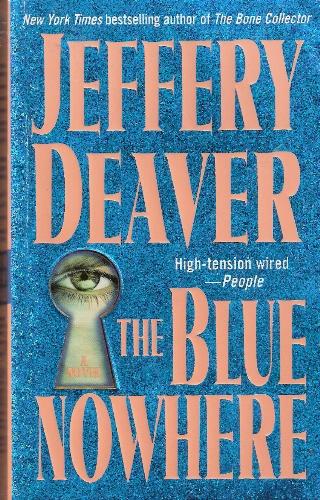
Review: The Blue Nowhere


REVIEWS OF BOOKS YOU (PROBABLY) NEVER HEARD OF. PART 3

Devious Deaver strikes again

A book review of The Blue Nowhere: A Novel

Those who have ever read a novel set in the world of Jeffery Deaver know two things. First, he picks out an area of interest, learns everything about it, and then writes a thriller that moves faster than sports cars drag racing on the speed limitless Autobahns. With A Maiden’s Grave, he explored the worlds of the deaf and of Hostage Negotiation, and has continued to win awards, acclaim, and movie rights for his novels centered on criminalist Lincoln Rhyme.

The second element: trust no one, especially the author, because even when you know he’s going to betray you, the problem is always how.


In his latest novel, The Blue Nowhere, Deaver enters the world of the Internet. In Silicon Valley, a sadistic serial killer code-named Phate uses computers to stalk and kill his victims. His weapons are a long, curved blade, a computer virus called Trapdoor, and a sidekick named Shawn. As with any decent serial killer, each kill is a challenge, and each subsequent murder must be more challenging than the last.

The California State Police Computer Crimes Division (CCD) frees world-class hacker Wyatt Gillett from prison. Gillett can make a computer board from miscellaneous pieces of junk and then make it work. His task seems simple: discover how Phate finds his victims, and how he gets into each of their computers. However, Phate is a genius to match Gillett’s own, and when the serial killer murders one of the CCD, Gillette is left to work with Detective Frank Bishop, a man who has more forensics savvy than computer intelligence. Not only does Gillett have to deal with Phate, he also has to tangle with a past that wants nothing to do with him, people from the Department of Defense who want to question him about problems of national security, and Shawn, Phate’s mysterious partner.

And, as I mentioned, you should never trust anyone… except your book reviewer.

Even with no interest in the Internet, the sheer speed of The Blue Nowhere is enough to make an average reader lose track of time and simply fall into the book. Deaver designs his characters and his world in such a way that they are as real as any in literature. The life story of each person is utilized masterfully, as Deaver both paints the background of their lives and twists it violently enough to wrench the book from your fingers. If this novel does not stimulate you, make you forget everything around you, and make you care for the people involved, it will at least educate you in what you never knew about the Internet, and were too scared to find out. It may even make you never want to use a computer again.

I would call Deaver a master of his craft, but that would make this sound like an introduction for an award ceremony. But The Blue Nowhere is a masterpiece of a thriller, with vivid detail, description, and plot fast enough to make a sonic jet look like the traffic flow on the LA freeway.

Buy it now, here: The Blue Nowhere: A Novel

Monday, June 7, 2010

FAQ #2: Casting Call

Another FAQ: Casting Call.


Ever since I started posting photos of characters for A Pius Man, one question has been who would play what role in the movies.

I'd have to start with how many people could be cut from the film first.

A Pius Man is a novel that is over 400 pages long. There are nine characters of varying importance, and while that composes an interesting fellowship, I doubt any film will accommodate all of them. So, any film would also have less character, as well as fewer characters, not to mention no ambiguity. Figuring out who's the lead may work in a leisurely novel, but movies have to move.


Maureen McGrail—physically, if you popped green contact lenses into the eyes of Jennifer Connelly, and gave her acting lessons and martial arts training, she would be good to go for the role. However, since I have yet to see her act, someone else would probably be needed; someone with a similar coloring. Preferably, someone who can fake an Irish brogue and kick some ass. Similar coloring would imply Megan Fox... but I have yet to see her act, either.


Wilhelmina Goldberg: the short, Jewish Secret Service technical geek..... There aren't many 5' actresses, and many of those who are don't seem to be geared to play computer nerd. Short and dark... unfortunately, no one leaps immediately to mind. However, given angles of the face, and the fact that her natural hair color seems to be anything but blonde, Sarah Michelle Gellar may work, if she can speak geek with a straight face. Given the way Hollywood casts people, I would be afraid that they'd cast one of the witches of Charmed—who are also short and dark (Rose McGowan is the tallest at 5'4”).


Giovanni Figlia—middle aged former Italian soccer player, with a build to match.

I wonder, does Billy Zane have a career anymore after Titanic?


Hashim Abasi—An Egyptian policeman who is also part of a think tank, with degrees in international politics. Physically, I always imagined him as Ben Kingsley after a weightlifting regiment. With reading glasses.


Sean AP Ryan—a hard role to fill. Take someone with “black Irish” coloring (black hair, pale skin, bright blue eyes), make him 5'6”, and at least looks like he can do his own stunts. He is mad, bad, and dangerous to know, a pleasant, friendly fellow, until you piss him off and he cripples you for life..... My problem there is, based purely on that physical description, I feel like someone would try to cast Tobey McGuire or Elijah Wood in the role—both are images that seriously make me want to acid wash my brain. Can I have a stunt man who can act?


Frank Williams—I can't imagine an actor who's in his thirties with silver hair and violet eyes, but makeup can do wonders. This requires an actor with a range that allows him to be soft spoken and quiet, and can probably beat someone to death with his bare hands.... I wonder Ewan MacGregor if enjoys playing shady priests...


Joshua Kutjok—the Pope. Tall, African, a very physical Pope. I would go for Michael Clarke Duncan, but I don't know how many different voices he has in his repertoire. Forest Whitaker is also a big fellow (6'2”), and seems to have gone through a workout regiment recently, and he played Idi Amin at one point,so he's done the accent.... there are possibilities here....

Scott Murphy—Once upon a time, this would have been played by Alec Guiness, who could practically play any role he wanted, with only a smidge of makeup and new clothes, and sometimes not even that. Currently the only one I've seen who has managed the same trick has been David Suchet—he's played terrorists, policemen, biblical characters, Terry Pratchett Characters, and Belgian Detectives. However, he left his twenties far behind him... also his thirties. Good acting can only go so far in making someone look younger. However, for a slightly younger actor.... Given the various acting jobs I've seen him do, I think Alan Tudyk should probably be on call for that one: I've seen him play nerds, neurotics, normal guys, absolute sociopaths, and Joss Whedon characters. He's a solid six feet tall, but I've only seen him look big maybe once—and with Lord of the Rings, we've certain seen the games that camera perspectives can play [no, Elijah Wood really isn't a midget.... really].


Manana Shushurin—even though I had based this character on a real person (on the left), I don't think I could coax her into playing the part, since she has a life. Based on physical build and coloring, some have suggested Olivia Munn—both the build and coloring match, and even the facial structure works, at the right angles, but I have no idea if she could act her way out of a paper bag.


Any thoughts on any or all of these, please comment below.