Another Podcast. This was fun.
But God I hate that photo.

This blog tracks the epic of kick-starting a whole writing career, with spies and thrillers, now saints and vampires. I cover the creative process, stuff that blows up, history, philosophy, and theology. If you like any or all of the above, you'll like this one. We talk about comic books, movies, music, and writing. Usually, all at the same time. [Note: All Amazon links here are associate links. Which means nothing to you, but it means Declan Finn gets a few pennies for the sale. Thank you.]
Another Podcast. This was fun.
But God I hate that photo.
Sorry for the lull between posts. But I wanted to collect some reviews out in the wild. Previously, I had posted these online one at a time on my old blog.
But yikes that sucks up a lot of time and effort.
So, I have some excerpts and links.
Enjoy.
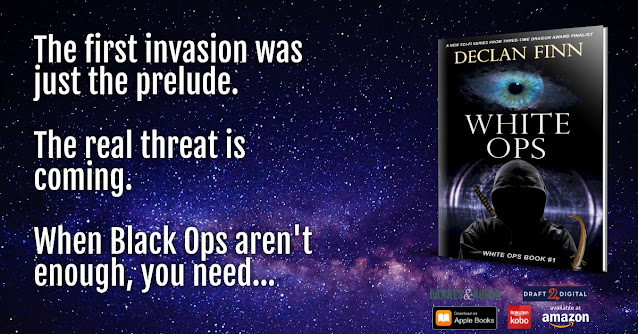
What do you get when you mix Star Wars, James Bond, The Hardy Boys, Chuck Norris and The Manchurian Candidate? Honestly, I get excited, but if you’re Declan Finn and you mix all of those things you get White Ops. What a thrill ride. Seriously, this was a really good time but it’s really hard to classify outside of being a Science Fiction novel. There is a lot here though.
The opening description of a ramshackle space colony, serving as the backdrop to a kayfabe barfight between Ryan and a partner, sold me on White Ops. For once in an indie secret agent space opera, the setting felt broken-in, disheveled, and grimy. The setting was brought into the foreground. And then Finn throws an ill-tempered space raptor headfirst through it.
So, I recommend trying these.
No, I don’t know where they get their episode titles from either.
People who have read my novels probably have noticed that I have the uncanny ability to predict the future.
Those who follow me on social media know that I’m not particularly happy about it.
The Pius Trilogy wasn’t all that bad. I mean, only some of it came true.
But geez, Saint Tommy drove me nuts. I wrote a particularly horrific circumstances, with demons and a cult motivating it and the circumstances around it… it becomes law.
I have a conclusion to a massive three-book conspiracy… then New York state codifies it.
I have an entire book centered around AntiFa minions acting as muscle, burning down entire cities, rioting, and generally carrying on cranky. THAT one I wrote in February of 2020, before the “summer of love” burned down a city or two for a few hundred days.
Hell! I have enough demonic politicians and scuzzy evil bastards that I’m still pissed off at the whole Qanon thing. (Demonic pedophile politicians? I killed those guys like three times!)
This got to the point where I said, screw it! I’ll use ripped from the headline stuff from years ago, and modify it. At least I can’t have these things come true, they already ARE sort of true. (Then freaking CNN producers started running pedophile rings! AYFKM? Thankfully, that book isn’t published yet.)
How do I do it, you ask? I reductio ad absurdum—I take everything out to their dumbest, most absurd end point. The point where no one, and I mean no one in their right mind would ever think about going. Then I have fun with it.
So of course, I have my plot elements become headline news.
Because there is nothing so freaking stupid that can’t become a political platform!
Why do I bring it up? Why isn’t there a post here on alien design and how I built a culture? You know, like I wanted? Why am I writing this post in the evening, far after I’ve usually shut down for the day?
In Politics Kills—which is literally releasing today—I had Earth under martial law. A tyrannical dictator locks down the planet and turns it into an armed camp. Anyone who disagrees gets arrested, thrown in jail, and disappeared.
So the night before the book releases, Justine Castreau in Canada declares emergency powers.
Really? Emergency powers? What? Did someone give this guy Attack of the Clones and he thought it sounded like a great idea?
Seriously, could the bastard son of Castro have waited five minutes? Maybe a day or two? Argh.
Right now, I’m hoping—really, truly, madly deeply hoping—that everyone looks at Justin Trudeau throwing a fit and goes “Really? AYFKM? Go have sex with a goose while the adults go talk with some truckers.”
There’s a saying among historians, and anyone who pays attention to history, is that history happens twice. The first time is a tragedy and the second time, it comes through as farce. And oh boy is this a farce. “Let’s break out emergency powers! Some truckers are parked in town, they’re honking, and they’re building shelters for the homeless and bringing in bouncy castles for children!”
I’m sorry, the level of stupid makes my brain hurt.
Anyway. I’m marking this piece, right here and now, so I can say “called it” at a later date. Just one of many stupid things that I called by complete accident. But nothing would please me better than to look back on this post and go “well, that was a wet firecracker.”
If I’m really lucky, it will have been misreported, no one is actually putting up with this crap, and this was all for nothing. I will have been pissed off by wasting my time, but frankly, I will prefer NOT having called this one in fiction.
For once.
Anyway, Politics Kills is out to day, please buy it, and let me know what you think.

White Ops is my first book, and therefore, it is a very long story just to detail how it became a novel that long.
If you’ve followed my ravings online, the story of my writing career—and the story of my life— can be summed up in one phrase.
“And then it spiraled.”
White Ops started as fan fiction. It was going to be a short story to get something out of my brain.
Fifteen months and six novels later, you could say that it spiraled.
Much of the book as is came about in the last few years. I’ve been rewriting this space opera epic for the past two decades, and so it looks very little like what I started it as.
For right now, the overall effect is looking at it like Lord of the Rings. Because when I steal, I steal from everyone.
And I do mean
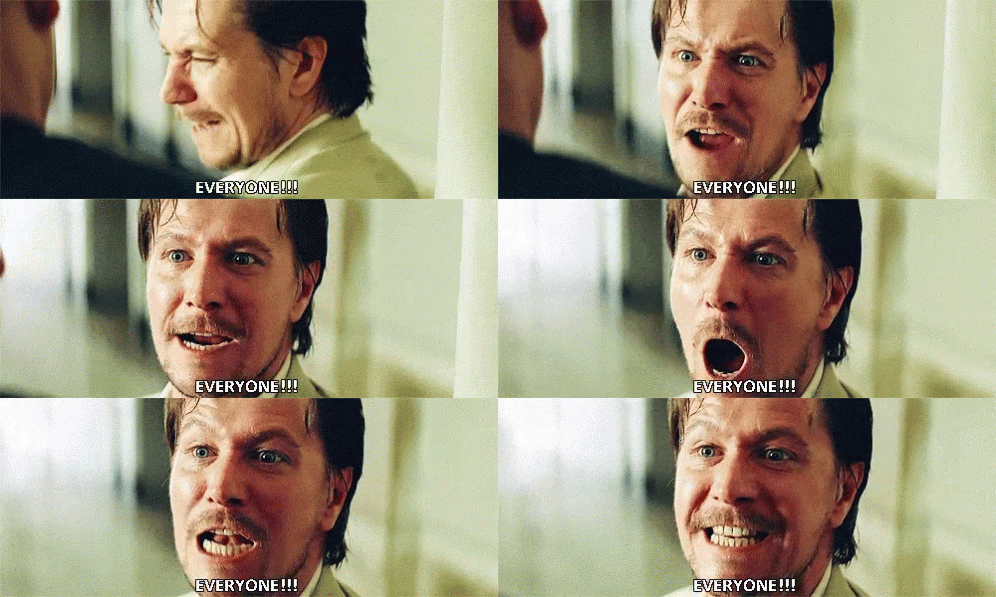
In the beginning, we have a massive war. A relatively backwards race called the Pharmakoi have had a massive technological spike. For years, they had been harassing the Renar race, but the Renar put them down and moved on with their lives.
Then, seemingly overnight, the Pharmakoi became the technological equals to the Renar, and all Hell broke loose.
Then
But, like Lord of the Rings, we have an emerging evil getting ready to rock and roll across the galaxy. No, they’re not some ancient threat like Sauron, and they’re not some alien enemy from a thousand years ago, like Babylon 5. They’re not even from a different part of the galaxy, like Deep Space 9. No, these guys are from a different galaxy.
But like Lord of the Rings, these monsters have the ability to reach into the blackest part of the human heart, and bring forth the darkness within.
While he doesn’t realize the full scope of the coming threat, one man sees it coming. His name is Sean Patrick Ryan. The Pharmakoi’s sudden technology spike make Sean think that the Pharmakoi either found the technology, or was given the technology.
If the Pharmakoi found the technology… how and where did it come from? Who left it? And how likely is that?
If the Pharmakoi were given the technology… whoever is behind the Pharmakoi wouldn’t have handed over their best weapons. They would give out the equivalent of muskets while owning nuclear weapons.
When the Pharmakoi go down, it’s only a matter of time before whoever’s behind them comes out of the woodwork. While everyone prepares, someone has to keep watch, and counter any moves this new race makes.
These people will be White Ops, and Sean Ryan will lead them.
This is the point where we have to explain what the Hell Sean Patrick Ryan is.
And this is where the background on the book gets complicated.
While White Ops is the first book I wrote, it didn’t even have that title. The original title was Tales of the Rangers.
Then I realized that “Rangers” is a term so overused, it might be the most generic thing in the SFF genre. The books became Tales of White Ops. Then, simply, White Ops.
Then I went off and wrote a dozen novels. Half of them ended up with Sean A.P. Ryan, because the Ryan family won’t leave me alone. More on that here. Later on in life, the 21st century Ryan wanted to be a pirate.
Okay, he would be a privateer. He would kill terrorists, steal their loot, then use that to finance killing more terrorists—repeat.
While I haven’t written those books yet, they’re in my head. They’re can(n)on in my universe. They are a thing.
Then I went back to perform a massive rewrite on the world of White Ops.
And Sean AP Ryan had screwed up my ENTIRE UNIVERSE. How?
Somehow, and I don’t know why, but the Renar had made first contact on a covert level sometime in the late 21st century. They reached out based on their own cultural assumptions. The Renar culture is big on robes, and the colors in the robes explain a lot about your position in society—well, robe color and weapons.
When the Renar observed Earth to see who to reach out to, they made a decision that this one place near the equator —the center of the planet — must be the place where the leader of Humans lived. And there was one guy who wore pure white robes, with constant international communications. Even the name, Pontiff, implied he was a great leader.
So, the Renar visited the Pope.
The Vatican said, “Please hold, we want to talk with someone.” In comes Sean AP Ryan’s privateer company to consult on the matter.
The Renar hear what Ryan does for a living, and thinks it’s a great idea. The merchant caste thinks it’s a great way to make money. The religious caste thinks it’s a way to do good. The soldiers think it’s a great idea to get into fights, and for good causes. The peasant caste … doesn’t really get a vote, but it seems like a good way to get out of blue collar work.
Take the idea back to Renar, filter it through an alien culture, and shake well for 300 years. Privateers became Toten’tanzers.
In the Renar language, a Toten’tanzer is “one who dances with death.” In context, it reads as “a sentinel against death.” You can translate it as a Ranger, if you want to.
If you’re reading the word and wondering “Is Declan using German and passing it off as an alien language?”
You might say that, I couldn’t possibly comment.
You’re also reading a guy who stole Gaelic out of a Dublin phone book for an alien language. I just throw the kitchen sink in and see what works.
Sean Ryan’s White Ops team is a subsection of the toten’tanz. They’re going to seek out new threats and new conspiracies, and they’re going to send them all straight to Hell.
Why why Ops? Black Ops are usually the sort of thing you don’t want people to hear about, because they may be morally iffy.
White Ops are fighting the good fight, but right now, we don’t want the enemy to know that we’re onto them.
You might be able to tell, but I had fun here. I’ve got a small cast of characters, only six or seven. It shouldn’t be too cluttered or confuse too many people.
So, White Ops comes out tomorrow, and this link should have most of the available vendors.
The second one comes out in a month.
It’s been so long since I’ve updated you all on the miscellaneous things I’ve been doing, I haven’t even given you folks an update since October. October! Oy!
First things first: Patreon. I have the first seven chapters of Honeymoon from Hell #1: The Neck Romancer, online.
You can visit my Patreon here if you feel you must start reading this book right this minute.
If you can wait for it to be entirely finished, then you’ve got a few months.
Next, I’ve been writing reviews.
So many reviews...
These are all the ones since the last update.
When the Gods Fell, by Richard Paolinelli
Zombie Death Extreme: Neeta Lyffe, Zombie Exterminator, by Karina Fabian
Part-Time Monster Hunter by Nicholas Woode-Smith
The War Revealed, by Karl Gallagher
Storm Between the Stars, by Karl Gallagher
Night’s Black Agents by Daniel Humphreys
Sworn to the Light (Avatar Wizard #1)
![Sworn to the Light: The Avatar Wizard - Book 1 by [Denton Salle]](https://cdn.substack.com/image/fetch/f_auto,q_auto:good,fl_progressive:steep/https%3A%2F%2Fbucketeer-e05bbc84-baa3-437e-9518-adb32be77984.s3.amazonaws.com%2Fpublic%2Fimages%2Fae7b5483-e924-41ea-978c-81d0a742d371_312x500.jpeg "Sworn to the Light: The Avatar Wizard - Book 1 by [Denton Salle]")
Blood Cartel, by Nicholas Woode-Smith
![Blood Cartel: Urban Fantasy Action (Kat Drummond Book 2) by [Nicholas Woode-Smith]](https://cdn.substack.com/image/fetch/f_auto,q_auto:good,fl_progressive:steep/https%3A%2F%2Fbucketeer-e05bbc84-baa3-437e-9518-adb32be77984.s3.amazonaws.com%2Fpublic%2Fimages%2Fa7579dd4-baa2-4332-abfc-87b2211a10e0_333x500.jpeg "Blood Cartel: Urban Fantasy Action (Kat Drummond Book 2) by [Nicholas Woode-Smith]")
Grave Injustice, by Allen Goodner
![Grave Injustice (The Angels' Executioner Book 2) by [Allen Goodner]](https://cdn.substack.com/image/fetch/f_auto,q_auto:good,fl_progressive:steep/https%3A%2F%2Fbucketeer-e05bbc84-baa3-437e-9518-adb32be77984.s3.amazonaws.com%2Fpublic%2Fimages%2Fd3c68338-8787-45bf-b53c-3d214d96975b_333x500.jpeg "Grave Injustice (The Angels' Executioner Book 2) by [Allen Goodner]")
Between Home and Ruin, by Karl K. Gallagher

Let’s see, what else am I doing?
I don't even know anymore. I'll figure it out.
[PG-13/ R. And, for the record, this is a completely amoral blog post—preaching morals gives me a headache and upsets my ulcer. So I’m not going to comment on “X was immoral.” This is a WRITING POST.]
Were this a song parody, the next line would be “absolutely nothing.” But, given that I've had bad experiences with song parodies, I will forgo that.
But, seriously, sex in books… why bother? In the context of the written word, almost any novel with a sex scene in it has been, in my opinion, a horrid waste of time, energy, and irritates, at least, this reader.
I don’t use sex scenes. Why? Because I find them boring.
I am not certain how much of this is my own personal opinion and how much of it is a critique of how sex scenes tend to be inflicted on the reader.
One of my major problems is the OSS, or the Obligatory Sex Scene.
For example: In the Douglas Preston/Lincoln Child novel Mount Dragon, our protagonists, after having found shelter and water in the middle of the desert, after nearly dying from thirst, while on the run from a nutcase with a gun… are so happy they start having sex…
Huh? What the Hell?
The OSS I just mentioned is quick. If it's longer than half a page, I'd be surprised. But it was just dropped into the middle of the book, and was so jarring it broke the pace. It had been a nice, solid thriller, our heroes on the run from a psychotic killer with a rifle, and then… they're stopping to have sex? Really? Weren’t you two just dying about a minute ago?
Looking at it objectively, what is the point of an OSS?
“Physical intimacy shows the the relationship involved has gone to another level and has thus impacted the characters.”
Perfectly true, but does that necessitate a five page sex scene? Or even a page? If one wanted to tell the reader that, yes, two people slept together, I can do that right now: “X and Y fell into bed, kissing passionately as they stripped each other's clothes. They then turned off the lights and hoped they wouldn't wake the neighbors.”
Done. Two lines and a bit of smart ass can carry something a long way.
“Things can happen during the scene that are relevant to the rest of the novel.”
True, but rarely does it necessitate going into intimate details. In fact, I would suggest that anything interesting that happened could be covered in the next chapter. “On reflection, s/he noticed something odd while lying on his/her back. S/he didn't really notice it at the time, but now that it's quiet…”
Done.
Exceptions can be made to this rule, obviously. If the couple rolls off of the bed as someone walks into the room, be it with room service or with a gun, then that is a useful detail.
Now, I’ll admit, there are moments when character can be served, strangely enough. I have seen a few sex scenes done well. I don't mean the sex scene in the novel Darkly Dreaming Dexter, where he dwells on a nice neat serial killer, his girlfriend comes in, starts kissing and disrobing him, and the next line is, literally, “How did that happen?” I mean a sex scene, rating R to NC-17.
John Ringo’s “Paladin of Shadows” series (Ghost, Kildar, etc), has sex scenes and nudity. However, the point of the hero, nicknamed Ghost, is that he is not a “nice guy;” he hangs out in strip clubs, and some of his contacts are strippers… it’s rather amusing reading a scene where a stripper is informing him of pertinent information during the course of her duties.
The sex scenes themselves are surprisingly thought out. The first novel, Ghost, is a series of vignettes. The second vignette is described as "two-thirds bondage porn and deep sea fishing, and who knows which is worse" (I’m paraphrasing). Before the sex scenes take up whole chapters, the character Ghost has a discussion with the two young ladies he’s dealing with… and their parents. The conversation that follows is one part dissertation on bondage subcultures, and five parts comedy routine.
After that, you can skip read, unless you really want to learn more about leather goods than you ever really wanted to.
So, here we have someone who makes sex funny without it being gaudy. In fact, the amount of thought put into his later sex scenes shows a lot of character, intelligence, and humor.
Even then, are they necessary? Surprisingly enough, some are, and two are crucial to the stories they show up in. Almost all of them impact the characters in some way. And almost all of these scenes can be entertaining for reasons that are anything but sexual.
Why Ghost does what he does (and I don’t mean sexual maneuvers or positions) tells the reader more about the character than a hundred pages of sex scenes from any given novelist…
Laurell K. Hamilton, I’m looking at you.
Seriously, when discussing unnecessary sex scenes, she is the elephant in the room.
Laurell K. Hamilton created a novel series about Anita Blake, Vampire Hunter. It was a nice, solid series, set in St. Louis, with a well-constructed, detailed world, where vampires were public figures, werewolves are treated like HIV cases in the 80s, crosses work against vampires, and demons aren’t the actor in a suit you see on Buffy the Vampire Slayer.
For eight or nine novels, the series went well. There was sexuality here and there (a major character was a French vampire, after all), but it never really got in the way of the story. By book seven and eight, the main character was sleeping with both a vampire and a werewolf, but the OSS’s were few and far between, and they were easily skipped by turning a page. Quite painless, overall.
After book #9, Obsidian Butterfly, I was warned off several novels because they opened with a hundred pages of vampire rituals of who gets to have sex with who. I went back for book #15, because it featured the return of Hamilton's best, scariest character: a mild mannered, white-bread fellow named Edward… he’s a mercenary who started hunting vampires because humans were “too easy.”
However, I had to skip a hundred and fifty pages of the novel. It was one, long and drawn out OSS. Not a menage a trois, but a bisexual sextet among Vampires and were-creatures. Much of the rest of the book had pages of Anita Blake defending her sex life. “The lady dost protest too much.”
When the author herself was asked about the overabundance of sex during a Barnes and Noble interview, Hamilton’s defense was
“I only get complaints from men. I had two reviewers tell me that they're disturbed that a woman is writing this sort of stuff. ”
Uh huh.
This feels like the story should end with “and then everybody clapped.”
Ahem...
If I may respond…
And this is my blog, so I can…
Dear Madam, Hamilton,
I get disturbed with John Ringo writing about a man and two coeds on a boat with bondage gear. For the love of all that’s Holy, what makes you think that a bi-sexual sextet with were-furries would go over any better, no matter who or what you were? You’re going to defend against criticism with some kind of strange faux-feminism based off of two reviewers who may or may not exist? How about "I want more plot than sex scene," are you going to blame that on me being male? Really? Really?
Again, I'll go back to John Ringo, only a different series — The Council Wars. One short story is seriously NC-17, and reading through it, I would be hard-pressed to see how it could be written otherwise.
With Hamilton’s novels, I could skip over a hundred pages of sex and not miss a single plot point.
That’s not “you wouldn’t object if I were a man.” That is just screwed up.
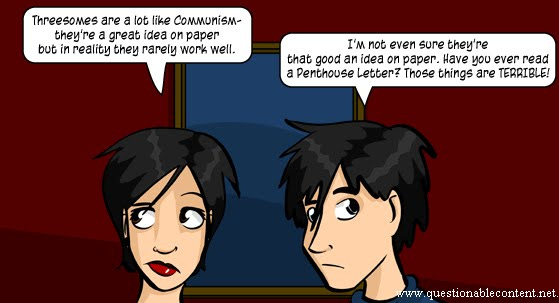
As I said, as a rule, I don’t do sex scenes. I will, on occasion, have moments of physical intimacy off screen, that the reader doesn’t see, but that’s about it.
Can I write a sex scene? Sure, they’re easy. In the past, I’ve gotten requests from lady friends of mine for erotica (don't ask, long story).
But are they necessary in fiction? No. And no. And hell no.
Did I need intimate details to add to the plot, the character, or anything related to the story? No.
Frankly, I think a PG-13 novel sometimes requires more skill than an NC-17 rated. I find that sex sequences are a cheat, sort of like premium cable—just because you can use four letter words doesn’t mean you have to write them into every single line.
I have actually made my lack of OSS’s in my novels work for me.
(For a quick example: The character of Sean A.P. Ryan has had a long term girlfriend… they’ve never had intercourse because every time they do, someone tries to kill them.)
Just because an author can throw in a sex scene doesn't mean s/he must do so. Doing sex scenes well takes skill, and making them relevant takes talent; most people don't have it.
Joss Whedon's Buffy the Vampire Slayer had several moments where our heroine's sex life really was going to get people killed.
Sherrilyn Kenyon, a ROMANCE NOVELIST, wrote at least one book where the LACK of sex was a key plot point, and another where intimacy between the hero and heroine was surprisingly crucial to the story.
Ringo was mentioned above.
So, it has been done well. Just not very often.
To answer the opening question: Sex, what is it good for?
In novels... it can be good for something. It just rarely is.
We’ve covered sex.
Now a quick word on violence.
Ahem.
Violence: what is it good for…?
A lot more than sex is.
I have heard multiple answers to the question: “Why put fight scenes into a novel?
David Drake, author of dozens of sci-fi novels, and Vietnam Veteran, has said that he puts fights scenes in to honor those that served, who had been there, done that.
That is a great, good, and noble answer.
Not mine.
My answer is: “A is trying to stop B. B will not be stopped with words. Time to incapacitate B. Chaos ensues.”
I will not say that violence is always required in a story. If you watched the series Burn Notice, it was practically built around a limited use of violence—tricks, blackmail, lying cheating and stealing, but rarely violence. It is like Mission: Impossible, or MacGyver for the dark side.
Like with sex, violence can be a cheat, a substitute for a plot. This is more obvious in the novels where the violence is more about brutality than anything else. When you consider that the average fight may top out at around five seconds, a long, drawn out, Steven Seagal-type battle royale is more of a dance routine than anything else.
Tolkien’s novels were part of a war story. In the current day and age, much of warfare has been / can be done with Special Forces troops. A war waged with SpecOps is still a war.
And, the bible aside, there are few audiences that will allow a book to get away with something as simple as “The two of them struggled, rolled towards the edge of the roof, and the enemy fell off.” Right there is a failing grade in any creative writing class.
Jackie Chan pointed out that there is a difference between violence and action—it's hard to think of his action films as overly violent when you consider that he came out of a ballet company. When one observes the original A-Team, one of the running jokes among tv watchers is that there were thousands of bullets fired, but no one was shot.
Like with Burn Notice or MacGyver, guns are tools, not solutions.
In the case of my books, have both fight scenes and action sequences. Have two people stand there and pound on each other is boring at best, gratuitous at worst. Have a running battle leading someone into a trap? Slightly more interesting.
For example, in A Pius Man, every fight scene serves a function. It leaves a clue, tells the audience something about the enemy, their motives, and their identity. Why would X group attack Y person? The level of force and determination can indicate the enemy's strength of numbers, the weapons they have access to, what intelligence they have access to, etc.
I tend to overthink things in my day to day life, so fight scenes occasionally get the same treatment.
I also try to have action sequences and fight scenes serve character... granted, in some of the oddest ways imaginable. For example, one thing they all have in common is that the only fair fight is the one they win. Letting the bad guys draw first is for suckers and dead men.
Some examples, and I’ll use one of my earlier works, A Pius Man.
Individually....
Matthew Kovach: Appears briefly in A Pius Man, but is a primary character in the second novel, he’s interesting in terms of fighting style. His thumbnails are grown a little long (“the better for gouging, my dear”) and his main weapon—his pens. He knows twelve ways to kill someone with a ballpoint, and several more ways to disarm and incapacitate them. When things get really nasty, he has his fountain pens. He also spends most of his time running, so he can hide and get into a good position to attack from. He's basically an academic with an odd past; as he says, violence finds him.
Sean AP Ryan: being a former stuntman, his fighting style is… psychotic. “Why are you using moves out of The Matrix?” Answer “Because I can do it without the wirework.” He carries a tactical baton around with him at all times—because there are occasions when he needs to take someone alive.
I’ve practiced with a self defense system called Krav Maga, which is about practical defense. Krav Maga even disdains the title “martial art,” if only because there is no art. We practice eye gouges, train for anti-weapon tactics, guns, knives, long guns, uzis … and any other weapon added to the itinerary.
In the case of Sean Ryan, he has an “expert” level in Krav Maga—which means he can face multiple attackers with multiple weapons. However, he uses moves that most Krav practitioners look at and say “No. Flipping. Way.” When he is outmanned and outgunned, Sean tends to become even deadlier. There's a reason he lists his resume by property damage.
Giovanni Figlia: as a former soccer player, Giovanni prefers a good solid kick to the groin, or headbutt to the face. As well as the occasional suicide dive into someone's stomach. “SCORE!” Also, being a former cop, he believes in the power of handguns and body armor.
Maureen McGrail: elegant and deadly. For reasons undisclosed, she started taking martial arts from a relatively young age, well before she got into double digits. MMA for the dark side, she has used bits Krav Maga, some have said Kung Fu, as well as penjakt silat (an Indonesian fighting style where punch defenses equal lethal force). She doesn't carry weapons, she is the weapon. The only people she needs to kill are the ones who just won't stay down any other way. And in A Pius Man, a stake to the heart may be required.
Hashim Abasi: He is, at heart, a street cop. A street cop from Egypt, but a street cop nonetheless. While he has some experience with a sword, that's not exactly practical for carrying around in the street. He prefers using his bulk for a standard kick-punch-elbow combination, and knows most ways to disarm someone. Think of it as an abbreviated Krav Maga.
Scott “Mossad” Murphy—a brilliant spy, but his philosophy is that if he needs a gun, his job had failed. Also, the last time someone gave him a handgun, he nearly blew his foot off. In a fight, he prefers to use his innate ability to blend into a crowd the shadows, and anything else available. On an intellectual level, he knows how to fight. On a practical level, it's a good day when he doesn't kill himself during practice drills. When possible, he prefers improvised weapons that he can launch from a distance—the further the better. If he must go up close and personal, he prefers a heavy object he can deliver to the back of someone's head.
As I said above, I tend to overthink everything, and at points, so do my characters. I have yet to have one novel that did not have a scene of analysis immediately following an action sequence. The protagonists examine the weapons used (local? Foreign? Military? Civilian? Homemade?), the tactics (professional or amateur? How many operatives?), and, if there are any survivors, the people themselves (accented? Languages spoken? Do they respond to interrogation?). You can see why a two page fight scene can be broken down into a three page discussion about the implications.
So sometimes, even the fight scenes are a clue.
When we get to White Ops… well, now we’re just back to a war story.
As you can see, there are more things that can be done with violence than with sex. Violence can move the story forward a lot more easily than sex can.
Sex can move the story forward, but very rarely, and it takes a deft hand. Violence is conflict, and conflict moves the story. Sex… is very much not conflict, and if it is, I’m not quite sure I want to read it.
You want sexuality and art, check out Martina Markota on any of her visual media. You want porn, read literotica.com.
If you want a story… then tell a damned story.

