Showing posts with label thriller. Show all posts

Wednesday, October 23, 2019

NEW RELEASE: Dances With WereWolves, A Merle Kraft Novel (part one)

From the creator of Too Secret Service (me) comes the latest self-published thriller....

Dances With Werewolves.

Yes, really. I'm a smartass. If you didn't know before, now you know.

Sigh .... and, according to Amazon, I have to warn you that every link in the entire blog is to connect to an Amazon Affiliates link-- and if it isn't, let me know -- which means I get additional money for selling you my books. And anything else you might purchase from that visit. So if any of you are interested in buying a $1000 television from Amazon, please, click on a link, then buy the tv. :)

Anyway, back to being serious, this book is special.

Because it's a Merle Kraft novel
Secret Service Agent Wayne Williams is dead. But he has to keep busy somehow.

When a coven of witches reports a threat to the President of the United States, it's the sort of threat that must be investigated. But it sounds like a vacation for Wayne.

CIA Assassin Catherine Miler is on a mission to kill Baron Samedi," a Prime Minister sacrificing American Tourists.

Author Matthew Kovach is looking for his own version of Derry Maine.

All three are about to find themselves embroiled in San Francisco pagans, want to be vampires, pharmaceutical zombies, and New Orleans.

And all three have to survive their consultants on this case -- the Kraft Brothers.

If I were to give you a one-sentence summary of the book? Think of it as a modern Live and Let Die.

Take a look, and see what you think about the insanity that is Dances with Werewolves.

And if you're a fan of audio books, please remember the ongoing Kickstarter campaign for Hell Spawn.

Tuesday, January 29, 2019

Writing Infernal Affairs

When I wrote Hell Spawn, I was shooting for a police procedural that became a horror novel. Check that.

When I wrote Death Cult, I was told it was okay for me to start things a little faster this time.

Never tell me that the pace must go "faster." I will accommodate you.  Then probably run you over.

Despite opening book 2 with a zombie attack and ending it at raiding a death cult compound, one beta reader told me it was "too slow."

That's probably even worse than telling me the book needs to be faster.

So Infernal Affairs started with a church shooting during mass. Shot priest. Screaming civilians.

Then the SWAT team knocked down our hero's door.


Then the car bomb.

Image may contain: one or more people and nightThen the full frontal assault.

Then the chase throughout New York and New Jersey.

The balrog on the highway.

The parkour chase over Manhattan with hellhounds and MS-13.

You know, the little stuff.

So this one was more of a chase book than anything else. Less horror, more urban fantasy. No modern politics, a little investigation, but a lot of fighting the forces of darkness.

But by the end of the book, I had to wrap up a few things from the previous books. After all, I had a demon, I had the cult that summoned it, I had a "warlock" in the background, MS-13, and now I had to do one thing above all else....

I had to tie it all together and make it make sense.

I think I did a fairly good job of doing that.

Now our heroes have to find out who the warlock is before the warlock gets them. It's going to be quite the bloody mess.

Yeah. If you had even HALF as much fun reading this as I did writing it, you should just bulk the series in hardcover as a set so you can gift it to friends ... or to people you want to piss off ... or both.

Anyway, Infernal Affairs. It's out and ready for the fun to start.

While you're waiting for Infernal Affairs to arrive in the mail, or download, then I ask you stop by the Amazon pages for Hell Spawn or Death Cult and leave a review. Trust me, they help.

Wednesday, February 14, 2018

Coming to a Close: The Last Stand of the Pius Trilogy

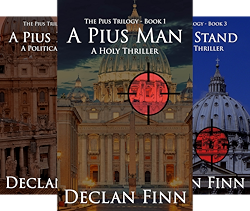
A Pius Stand: A Global Thriller (The Pius Trilogy Book 3) by [Finn, Declan]
This has been a busy week for me. First there was Planetary: Venus, and tomorrow, A Pius Stand: A Global Thriller is coming back.

The Pius Trilogy, at long last, is coming to a close. I'm almost done. The stories and the book of history is coming next, and then the rerelease is closed up.

You know how hard it was to say goodbye to this thing the last time I did this?

I've actually been rather busy going through a lot of different things, so I haven't really be able to dwell on this thing finally being put to bed.

I wrote the original one-volume A Pius Man novel in 2004, during a slow season in my graduate studies -- I had written my Master's Thesis, For all their Wars are Merry, during the winter break. This original volume had guest appearances from Merle Kraft before he met vampires, Marco or Amanda. It was before Middle Earth's Most Wanted Elvin Assassin had grown into a character and took over whole novels.

The Pius Trilogy (3 Book Series) by  Declan Finn
And now, 14 years later, I can finally say goodbye.

The Pius Trilogy is the second longest running project that has consumed my life. I was 22 when I wrote it, and I'm just short of turning 36.  The only other thing that has eaten up even more of my life is my space opera project, which I started when I was 16. That's something I hope to be rid of by the end of next year.

So, there is some emotion when I dwell on the conclusion of this project for too long.

It's not even so much a matter of never playing with the characters ever again. I have already done more horrible things to Sean A.P. Ryan in Set to Kill, a sequel to It Was Only on Stun! and a bit of an epilogue to The Pius Trilogy. And several of the characters are already slated to come back in other work .... in part because I had written Pius as a capstone to a dozen other novels I had written, using secondary characters as the leads. Obviously, those will have to be rewritten. But I will be playing in this sandbox again. I'm not done with these people yet. They all have a long road ahead of them.

But this will be the last time I relive (and rewrite) the deaths, some of the more dramatic moments. The Pope's kidnapping. The final stand of the Vatican against the forces of darkness. The people I've buried. The moment when I finally, at long last, put a stake through the heart of this one son of a bastard who JUST. WOULDN'T. DIE!

I think that the first time I really ever answered the question "What advice do you have for people who want to be writers?" was on Geek Gab, with Brian Niemeier and Daddy Warpig. I don't remember exactly what I said, but my answer is still the same.

If you want to be a writer? DON'T. You have no idea what you're getting into. You really don't. Getting emotionally entangled with the voices in your head? Staying awake because of the plots and action burning up your brain until you write them down? You don't know what it's like until you get into it. But if you have to be a writer, go for it, all in. Don't even blink.

But then you have a project that eats up your life, with characters you don't want to kill, but you know must die, because they won't stop until they pay with their last breath, and they're at war with beasts who won't stop until one of them is dead. You'd think it would be easy, considering they don't exist except on paper and in the head of the author .... but no, the author has all of the biographies of everyone s/he kills. You know how they like their drinks, and their favorite songs. You know that this character grew up wanting to avenge the death of his father at the hands of the Red Brigade. You know that this other character had a girlfriend who died during the Irish Troubles, and could never love again because everything he had left went to The Cause. You know that the other one is actually a lesbian who doesn't even want to BE in this Charlie Foxtrot, but she's fully aware that the Vatican is the right team to be on, even if this all ends in fire.

And no, most of that isn't even on the page for your reader, but YOU know it, because these people are yours.

So, yeah. That's the end of The Pius Trilogy. No more battles in the Vatican. No more warring on the streets of Rome. I can finally say goodbye to the story of Pope Pius XII, the Battle of Rome, and this particular battle against the army of darkness...Next time, I'll remember to bring the chainsaw.

Monday, February 5, 2018

Planetary Anthology: The Moon, open submission.

You will, of course remember that Superversive Press has a series of Planetary Anthologies. Each one revolved around the theme of each planet.

... They're doing 11 anthologies. One for the sun, and another for the moon. And yes, Pluto is a flipping planet, damn it.

The most recent open submission is for Luna, ... or The Moon anthology, depending on what sounds better.

Insert obligatory "That's no moon! That's a space station!" joke here.

Take a wild guess who is going to be editing that one.

Yes, me. No need to be so shocked about it. I'm allowed to handle sharp objects, and that includes the scalpel required for editing.... or the butcher knife, depending.

The theme for the moon will be relatively straightforward and obvious: dreams and illusions, despair and madness, isolation. You know, all of that fun stuff.

Stories should be between 3,000 and 8,000 words. Stories should center on themes of those mentioned above. You want someone going crazy during the full moon? Go for it. (Also see: Hollywood Moon by Joseph Wambaugh).  Want the last man standing from a mission to the dark side of the moon? It can be done (See: Rod Serling).

Do you want to write about a man crazy enough to believe he's a Middle Earth elf, but is the only thing standing between an astronomer and a legion of hit men out to kill her? You can't. I've already written it.

These are just ideas I'm throwing out there. The themes listed need not be specifically the primary plot, just part of the story.

Any genre is allowed, though science fiction and fantasy in any of the traditional forms is preferred.

Remember that this is Superversive press. There should be stories that speak to heroic aspects of man; man as he can be, not as he all too often is. The stories should to the reader’s soul. Make the reader yearn for the life that he ought to live. Nihilistic drivel need not apply.

Think this is difficult for a theme that revolves around madness and despair? Depends on the madness.

As Man of La Mancha put it:
When life itself seems lunatic, who knows where madness lies? Perhaps to be too practical is madness. To surrender dreams — this may be madness. To seek treasure where there is only trash. Too much sanity may be madness — and maddest of all: to see life as it is, and not as it should be!
Go out and do me proud.

Cut off date for submissions is April 1, 2018. The date may be extended depending on quality of submissions.

Send submissions to: planetaryantho@superversivesf.com

Thursday, June 22, 2017

Pius Writing

Over the years on this blog, I've talked a lot about how A Pius Man came about, and I've muttered about some of my research on it. I've talked about the characters, and their biographies, and their progress from being a biography to being a real person I play with in my head.

I don't think I've ever mentioned my thought process behind the evolution of the novel.

You see, once upon a time, I considered writing a murder mystery in the Vatican. I made the head of security an Irish redhead who had family with the IRA. I was going to murder a bishop or a Cardinal or something like that. I had a Hispanic Pope named Hector (I don't recall the Papal name), and a few other loose elements kicking around. I may have had a whole page of notes.

Obviously, when I started on A Pius Man, that project went the way of the dodo.

However, one thing that stuck was it was going to be a mystery. I wanted everyone to be under suspicion. I wanted everyone to look dark and sinister, and let the reader decide who to trust, and when they could be trusted. I wanted to cheat, like Agatha Christie, and make even the investigators look like they could be in on the plot.

I wanted it look, at first glance, like every other knock off of that idiot that shall not be named.

Not that anyone would know who that is.

**COUGH** **COUGH**


Basically, I wanted it to look like X. Because, hey, if it looks like X, X is a proven formula. X is harmless. X is status quo.

A Pius Man is at once both subversive and superversive. Superversive in content, but I totally intend to subvert the status quo of X stories.

Obviously, as the first 4-5 chapters are released, you're going to have to tell me how much I managed to make A Pius Man look like the stories we've all come to know and loathe, before the story kicks into high gear and becomes a knock-down drag-out thriller.

And of course, as I've mentioned before on this blog, it spiraled. Mostly because one son of a bitch just wouldn't die.

Again, what I intend may not be what you see, but then again, I'm the idiot who thought that Honor at Stake was a light, fluffy throwaway book. So I'm not the best judge of character.

But you are. Tell me what you think when you read it.


And, if you've done that....

The Dragon Awards are open and ready for nominations, and I have a list of suggestions you might want to take a look at. If you already  have a good idea of what you want, just click here to go and vote for them. The instructions are right there.


The Love at First Bite series. 


Wednesday, August 31, 2016

The Complete Works of Declan Finn

Yes, I'm still heading for Atlanta. I still have a blog to do.

You know, it's occurred to me that I should probably so something really strange .... and have a blog post that actually collects, you know, my books.

Yes, I know, I'm slow.

I'm going to be putting these together in order, sort of. Mostly in chronological by story. Most of these books are not really that tightly interwoven. For example, It Was Only on Stun! marks the first appearance of Sean A.P. Ryan, but you don't need to read it in order to understand The Pius Trilogy. Technically, you don't even need it to understand Set To Kill when that comes out.

Granted, I want you to buy all of them, but I'm not going to force it.


This one, everyone knows. Why? Because it's "murder mystery at a science fiction convention." I won't say it's typical at all, because, well, this one has terrorists, assassins, and a psychotic who thinks he's an elf.

Or is he?


A Pius Man: A Holy Thriller                                        A Pius Legacy: A Political Thriller 
A Pius Man: A Holy Thriller          


You've seen every Dan Brown knockoff in existence. You know, a Mozart conspiracy, or a Michelangelo Pattern, and Daniel Silva, or I don't know, someone else who decides to smash pseudo-history together with "high technology" MacGuffins. 

Granted, Dan Brown is actually a knockoff of James Rollins, who had been putting theoretical science together with mysteries of history well before Brown's train wreck of a series.

The Pius Trilogy is pretty much where I started in the general insanity of my writing career. Stun! came first, but Pius is what I was passionate about for years. It ate a decade of my life, and if you don't believe, me, I can tell you I went through two agents just getting there.

You want history? We got history.

You want a culture war? We fight it with real bullets.

You tired of seeing religion put on trial? See it mount a defense.

Hate lawyers? I think we shoot some.

War on God? God will have none of it. I'm putting the militant in "church militant."

We have an evil Cardinal, a psychotic mercenary, shady priests, a zealous Pope, and everything you think I'm going to do with them, you're wrong.

The follow up anthologies, which are really prequels, are


Pius Origins
Pius Holidays


But, you can get both of them in the complete Pius Tales.

There are some people who might suggest that this comes first before any of the other books. Technically true. All of the stories in these are the result of, well, promotion. I was trying to build up buzz for the Pius trilogy with stories about the characters.  That's how I had....

Sean Ryan vs. the IRA, on twitter .... and versus the meth dealers, on a public street...and in a mall on Black Friday
Scott Murphy, Catholic Mossad Spy, blowing up Bethlehem and Boston.
Jon Koneig, Mafia Enforcer, versus drug lords.
Father Frank Williams .... vs. terrorists on St. Patrick's Day.

Yeah. I had some fun.


On the one hand, this is out of order. Other books have come out since then. However, this is the cherry on top of the trilogy. It's the final straw, really. It's all the footnotes, to pretty much everything I used over the course of the entire series.

Because when in doubt, through everything out there, and see what's bought.


Codename Winterborn

The year is 2093. Lt. Kevin Anderson is a spy.

Then everything he knew and loved was blown up by corrupt politicians.

This means war.


Can you tell that I like that song?

Anyway, this doesn't have any connection to the other books. But I enjoyed myself.

Honor At Stake


And, of course, the Sad Puppies and Dragon Award nominated book, Honor at Stake.

If I haven't talked up this book enough lately, I have not done my job.

For All Their Wars Are Merry

Exactly what the title says.

So that's all nine books -- and I'm not counting the pieces and parts of Tales, it's just one book, as far as I'm concerned. I have at least three more that are ready to launch within a matter of weeks. 

Don't worry, I'm not going away any time soon.

Wednesday, January 13, 2016

Flashback Blog: So, you want to be a writer?

Originally posted five years ago, it was a filler post then. Apparently, it's a filler post now. Who knew?

With apologies to Doctor Who....


So, you want to be a writer?

Maybe not, but keep reading, you might be entertained.

The first rule that many people tell you in creative writing is “Write what you know.”

I'm going to tell you that this is the last thing you should do.

No one wants to read about your family drama. Do you think that Vince Flynn is actually a terrorist hunter? Or that Bob Kane dressed up as a giant bat? Or that Stephen King is a demonic clown?

Okay, demonic clown is redundant …

NOT me.
Saying “write what you know” is as ridiculous as suggesting that I am either: an athletic mercenary with enough weapons to take Latin America / a soccer-playing Vatican Secret Service agent / or a commando priest. [Edited: or a hot female Russian vampire]

I would recommend, generally, that you write what you read. Unfortunately, your writing will probably suck at first. Keep writing. It will still suck. Do it again. Repeat until you no longer suck. Trust me, I speak from experience. And from the experience of Timothy Zahn, John Ringo, and several other authors who discovered how to write the hard way –by writing.

That would lead to an obvious follow up: read.

Friday, July 17, 2015

The Politics of the Damned

I think we should talk.

Yeah, that's never a good sign.

I generally don't do politics on my blog. Okay, I haven't until recently with the Sad Puppies (click tab above for more details), but this week, I need to cover something. And it shouldn't offend you, because if it would, I'm reasonably certain you wouldn't even be reading this blog. You'll see in a minute.

But I have to ask. When did life become an evil? Don't leave just yet, because this has actually become a thing, and I'm seeing it more and more as time goes on. Life is not worth living and people are not worth allowing to live.  I'm not talking about a John Ringo novel where the stupid are eaten / blown up / killed in various horrific ways. No, that's a straight up Darwin Award.  I'm talking about a general contempt for life and living human beings.

Don't believe me? In 1998, there was a book called Rainbow Six. I'm going to spoil the book and the video game based off of it because it's 17 years old now, if you haven't read it yet, what are you waiting for? The bad guys in that novel were eco-terrorists who figured that the world would be just fine without human beings, and if the terrorists were the only human beings left alive to inherit the Earth, then the Earth would be just perfectly fine.

Our heroes couldn't arrest these sickos, so they invaded, took them outside of their modern compound in the midst of the rainforest, stripped them all naked, blew up the compound and said "Fine. You wanted nature. You got nature. The nearest town is a week thataway. Good luck."

Fast forward to 2013, and He That Shall Not Be Named wrote a book called Inferno that Dante would be offended by. The good ending for the novel was that 1/3 of the planet had been sterilized, and, "Oh well, the bad guys have a point. There really are too many people on the planet."

Uh huh. Yeah. You read that right. The bad guy was right. It would be too much trouble to fix it, and there are too many people anyway, so screw all of them.

Monday, July 9, 2012

Forget Sparta. I! AM! PUBLISHED!!!!!

I waited three hundred posts just so I can use that headline. Really....

...

Okay. No, not really. It just turned out that way.

But it's true. I'm published.  It Was Only On Stun! is available on Amazon.com.  Buy it here, now.  And you can also buy a kindle copy, right here. And a schedule for a virtual book tour, and maybe even a real life book tour, will be forthcoming .....

But I'm going to take a moment here.

I'm not sure you know what this means to me.

It's been fourteen years.

Two million words. Dozens of rewrites. Entire novels spiked. Two agents. A dead economy, "the end of publishing," and every negative thing about the business of publishing you've ever read in The New York Times.

There have been bridges burned with people whom I have deeply loved. There are people that I owe this to who are no longer talking to me. People who cared just enough to encourage me, but not enough to stay. There have been people I, admittedly, drove away while I was being driven insane by the thorns of this world.

It's been a long road, with a lot of work. I want to thank all of you who stayed around to read what I've had to say.

And, of course, there are specific people who have stuck with me that I need to thank, like: Jason Bieber, Karina Fabian, Kelly Garcia, Ester Lamm, Matthew "Funtime" Pryce, Allan and Annie Yoskowitz, Ann Margaret Lewis, various and sundry people from the Catholic Writer's Organization (Ellen Gable Hrkach, Jacqueline Vickers, Ann Seeton, and, of course, Walter Staples (who can now compare writer's notes with The Great Author). And, of course, there is my family, including my sister Margaret, who helped me with her editing services of Just Write! Ink (on Facebook).

I owe all of you. And I only hope I remembered you all in the acknowledgments. It's all been kind of a blur, so if I missed you, my aim will improve next time around.

Hopefully, you'll like It Was Only On Stun! to a ridiculous degree. You'll want to gift copies to all your friends, and insist that they do the same. Unlikely, but I've been living on hope and Red Bull for so long, I'm shooting for Mars (because the moon is just not ambitious enough). It's also a fairly kick-ass action, mystery, and comedy.

And, if by some chance you don't like it, well, I've got a dozen more books, each with a different flavor and style. The next book will be A Pius Man.  One way or another, it will be published.  Will it be by Amazon.com? Maybe. If that's the case, I'm going to have to find a way to pay Matt for his cover art.

Winston Churchill (everything interesting said in World War II is attributed to him), after the battle of El Alamein, said, "This is not the end. This is not the beginning of the end.  This is, pray God, the end of the beginning."

This is my beginning.

Thank God.

And thank you, too.

But, enough sentiment: here's a fun video with epic music, and weapons.


By the way, while this is an aside -- I also have a new website. Enjoy, all.

Wednesday, April 4, 2012

Fighting and writing workshop, day 5 and 6: military fight scenes


This is the online workshop in writing fight scenes that I did for the Catholic Writer's Conference.  Karina Fabian had managed to draft me ... or I volunteered, I'm not entirely certain.  Either way, it was an interesting little experience.

Since most of you folks have been with me for a while, I'm going to give it to you.

Don't worry, I wasn't paid for this, so giving this away for free will hurt no one. And, few to no people wanted to show up and play with my workshop, even though there were over 25 viewers for each post.  But, I've been told few people showed up anyway for the forums, something to do with schedule confusion.

So, here is day five and six.... Day five was merely an assignment. Day six was more interesting.


 Day Five: Putting It Together

At this point, you should have an idea of what you're doing. Take assignments three and four, and put them together. Whether you start from a weapon and go to hand-to-hand, or vice versa, is up to you. This is the assignment.

Like with most writing, practice makes perfect. So don't be discouraged if you're not writing full-scale battle choreography by now.

Day Six: Writing For Military Fights

Writing a military fight scene is no different from any other, when you get down to it. Do some research on terms, maneuvers, etc., but don't overstress that part. It's mostly just a matter of vocabulary.

But, seriously, there's little difference from warfare fighting.

Character: In describing filming for Lord of the Rings, and the Battle of Helm's Deep, director Peter Jackson discovered a basic law of fight scenes – Jackson had hours upon hours of stuntmen beating each other to a pulp, but the battle was boring when the camera was not on the primary characters.

The important thing you need to know is, no matter what, you need to focus on the individuals involved. The more modern your setting, the more things are done by groups of individuals, squads and fire teams, and not massive lines of fire, one against another.

However, no matter how many people you have fighting whatever enemy, you need to have individuals the audience can focus on and care about. Writing about a line of tanks is boring. Writing about someone the audience has met, and is invested in, is much, much better.

For great examples of this, read the Richard Sharpe series by Bernard Cornwell – he has, on average, about six players in any battle that he focuses on, as well as a massive, historical battle taking place.

Setting: If you want to focus on a full-scale battle, in whatever age and setting, one thing you'll want to focus on is the field of battle. You're going to want to focus on the sounds, and the sights, perhaps even the smells. You want to recreate it as though the battlefield is a character. A loud, monstrous, messy, rampaging character, with lots of property damage.

The best I've ever seen of this type of recreation is John Keegan's The Face of Battle, where he recreated the battlefields of Agincourt, Waterloo, and Verdun.

Hand-to-hand combat and weapons: Depending on the scenario, military battles do not start with close combat, unless it's a type of covert infiltration, where getting in close and killing people silently is important. And, let's face it, the use of weapons will vary wildly depending on what time period and setting you're using. For the most part, it boils down to individuals.


Tuesday, April 3, 2012

Fighting and writing workshop, Day 4: Guns in Fighting.

This is the online workshop in writing fight scenes that I did for the Catholic Writer's Conference.  Karina Fabian had managed to draft me ... or I volunteered, I'm not entirely certain.  Either way, it was an interesting little experience.

Since most of you folks have been with me for a while, I'm going to give it to you.

Don't worry, I wasn't paid for this, so giving this away for free will hurt no one. And, few to no people wanted to show up and play with my workshop, even though there were over 25 viewers for each post.  But, I've been told few people showed up anyway for the forums, something to do with schedule confusion.

So, here is day four.


***

Day 4: Guns in Fighting.

There are more weapons in Heaven and Earth than there are in Thomistic philosophy. However, guns seem to be the magic weapon that everyone uses, and uses badly. With any weapon you decide to use, make certain that you have a basic knowledge of these weapons, even if it's merely researching them online. This day will also assume that you've never even seen a gun up close and personal – perhaps an erroneous presumption, but I'm not going to assume everyone knows guns. If you have do know things about guns, please bring it up.

Weapons are tools. Knives do more than stab people. Lead pipes do more than club people over the head. And guns do more than shoot people. Don't get me wrong, guns are great. But if you're writing for someplace like New York, guns are not readily available to the general populace.

Remember Day One, writing the rules for the culture on fighting? Now you know why we bothered.

Everything in a fight has to feel fast-paced, as we said before. But when you introduce a weapon into any scenario, the characters and the writing have to move fast. Or at least intelligently. What do I mean by this? I mean that no one is going to outrun a bullet – the best they can do is be faster than the trigger finger of the person targeting them – but finding cover, providing distractions, and shooting elements of the setting or other uses of the gun.

In actuality, gunfights are not like an Arnold Schwarzenegger movie – if someone is moving in a straight line, a smart gunman will lead the target. However, smart gunmen do not use fully-automatic fire in extended bursts. Firing a full magazine of ammunition on full automatic will not lead to a stream of bullets that come out in a straight line, but will cause the muzzle of the gun to jerk around like a spastic mime having an epileptic fit. In a gun battle, at a distance, even slight deviations of the gun's barrel will cause bullets to go wildly off course.

Then again, stupid things happen with guns. The average shootout with the police takes place at a distance of nine feet, but three out of every four bullets will miss, mainly because everyone is popping in and out of cover, snapping off shots and hoping they'll hit something.

Again, now is not the time for technical terms. If you're writing for a medieval setting, or a fantasy setting, if specific parts of specific weapons are going to come into play, you may want to introduce them before the fight even begins. And, if you're using a technical detail of a gun that only people who field-strip their own weapons would know, don't discuss it in the middle of a fight. A previous example has been the Lee Child model, where his character Jack Reacher describes how a fight will turn out and why, before the first punch was even thrown. You can have such discussion then, but when the bullets start flying, try not to dwell too much on the pieces and parts.

You can, however, have a technical analysis as the hero/ine is taking cover, and thinking about what to do next. If the pieces of the gun are important to the solution, and you can provide a “lull” in combat (if that's how one can describe taking cover while being shot at), then by all means, make it relevant. However, you do not want to give the vital statistics on a gun in mid-battle. In fact, you might not want to go into it at all.

The most anyone needs to know about most guns might include:

Ammunition capacity: Do not use Hollywood forever shooters. You will want to reload – if only because it's more thrilling to have a count of how many bullets your hero/ine doesn't have. (Would the end of Die Hard work at all if John McClane had had a full magazine left, instead of just two bullets?)

Type of ammunition: This only matters for level of impact, and penetration. If it's a .22-caliber from a handbag pistol, you can stop if with a pocket Bible. If it's a .45-caliber, you will stop someone if only from the shock value (no one takes an impact from a .45, rolls into a doorway, and returns fire. It's gonna suck to be that person). If it's a .50-caliber handgun, you can disable engine blocks and amputate limbs. If you're writing science fiction, ammunition type is doubly important.

Type of gun: Revolvers, pistols, assault weapons, submachine guns, hunting rifles, and machine guns all have different strengths, ranges, weaknesses, and abilities inherent in the type of gun. You will not put a bayonet on a pistol, and no one should try to rob someone with a sniper rifle.

Length of weapon (optional): many handguns make for great blunt-force weapons.

Appearance: I'm a very visual reader. There are some guns that are very visually distinct: a FAMAS assault rifle looks nothing like an M-16, which looks nothing like an Uzi, which looks nothing like an H&K G-11, which looks nothing like an AK-47. However, there are a lot of knockoffs that resemble M-16s, AK-47s, and Uzis. You don't need make, model, and serial number; just say “it looked like X, Y, or Z” gun, unless you want to go into more detail.

In essence, you can boil down someone's handgun to “short-barreled .22-caliber revolver,” or “a semi-automatic that looked more like a hand cannon” (for an example of this, look up the image of a “Desert Eagle” .50 caliber.)

Note: Please remember that Kevlar is not a magic shield. At best, it will take that small metal object going at hundreds of feet per second, and redistribute its force so that your character will essentially feel like s/he's being slapped with sheet metal at ten miles an hour.


Assignment #4: Choose Your Weapon.

Take your setting, hero/ine and the enemy from assignment #3. Pick a weapon and put it into a fight between the two. It does not have to be a gun (for thoughts on weapons, and improvised weapons, check the “How To” article link in the initial documents packet). It doesn't matter if your hero has the weapon, or your villain does. It doesn't matter if the weapon was found at the fight location, or if it was brought.

If your hero does not have a weapon to start with, they will need to disarm the bad guy and/or find their own weapon.

Youcan check the how-to article again to at least get the principles for gun and knife disarms, though the principle is mostly based in common sense – don't get in the way of the weapon.

Remember, you do not need to have anyone killed, even if you're using a gun in the scene. Guns can shoot the environment, make people flinch, duck, or buy the characters time.

Monday, April 2, 2012

Fighting and writing workshop, day 3: Writing Fight Technique


This is my online workshop in writing fight scenes that I did for the Catholic Writer's Conference.  Karina Fabian had managed to draft me ... or I volunteered, I'm not entirely certain.  Either way, it was an interesting little experience.

Since most of you folks have been with me for a while, I'm going to give it to you.

Don't worry, I wasn't paid for this, so giving this away for free will hurt no one. And, few to no people wanted to show up and play with my workshop, even though there were over 25 viewers for each post.  But, I've been told few people showed up anyway for the forums, something to do with schedule confusion.

So, here is day three.


****


 Day Three: Now, Let's Talk About Writing Fight Technique.

There are a lot of basic moves that you don't need to describe too much. Most kicks and punches are like that, for example. You don't necessarily require a full description on a “forward vertical defensive kick” (as seen in the article on how to throw a stop kick) – you can just write “X kicked Y in the chest the way a fireman would kick down a door.” It's the same kick, just a less technical way of writing it.

Speed of attack: keep in mind that most fights don't even last for five seconds. A kick to the groin, a punch to the throat, and it's game over. Even a fight with a weapon can only last so long. Fighting over a knife will ensure that all sides get cut, and someone will be hurt in short order.

And, keep in mind, fighting is hard work. Even something as simple as punching is going to take a lot out of someone. If you don't believe me, go hit a punching bag for a minute. Punch it, kick it, headbutt it if you like, but do it at full speed, as hard as you can. You're going to find that it is very, very hard work. After the initial burst of energy, you're going to slow down after thirty seconds. Stamina should not be important in a fight, because most fights shouldn't last very long.

Another element to keep in mind: the enemy is also reacting. We don't need three-dimensional chess with hand-to-hand combat, but we also have to remember that (for example) kicking someone between the legs (even if they're feeling no pain), will still force the body to lean forward, and that opens up possibilities. If we punch someone, their head will go back. If we feint, they become defensive, preferably where we don't want them to be.

If you're going to have a long fight scene, it should be for a good reason. Either it's a war—in which case it's perfectly understandable—or there are multiple attackers, or both participants are very, very well-trained.

Yes, you can have a half-page of description for something that takes only a split second. You can have all of the technical details down cold, but you must at least convey to the audience the speed. And, even if you don't go into exacting, excruciating detail for your audience, you should at least know the mechanics, so you know what you're doing. Don't be insulted – trust me, I used to do that a lot.

If you like, look at the fights scenes of Lee Child's character Jack Reacher. He'll give a half-page dissertation on something like the tactical usefulness of a headbutt, or he will work out a fight, chess-like, before the first punch is thrown. He then does it, writes a few lines of the enemy's reaction, and keeps going.

Note: If you have formal training, or have practical experience in a self-defense system or martial art, realize that high kicks, spin kicks, or any kick that goes above the hip can pose a danger in a real fight. In a real close-combat situation, there are no rules, and there is no tapping out. This may sound patronizing, but trust me, there are plenty of people who try to use fancy moves they learn on a gym mat and try to use the same moves on concrete. It doesn't end well, sometimes.


Assignment #3: Writing Hand-to-Hand Technique

Look at the various articles assigned here: http://shar.es/giQgA. Choose at least one technique. Do not worry about plagiarizing; there are only so many ways to describe some moves. All that I require is that you use one element of one described technique over the course of your fight scene.

Step 1: Set up the fight, be it a mugging, or something with a minor villain, what have you. Write out a full technical description of what your character will do – not only with the technique, but most importantly with what comes next. (Continue to fight, to run, et al). How does the other combatant react/reply?

Step 2: Give reasons for their actions, and how it fits with your character.

Step 3. Repeat step one, only take the entire technique and condense it. Boil the technique into only a paragraph, at most. Now that you know what your character is doing, there's no reason to belabor the point for your audience. You can go into great detail, if it's an obscure method, or if you have a style similar to Lee Child, described above. You don't have to do one or the other in your writing, but you should at least be able to do both.

Please note: when writing your fight scene, be certain that you, and your readers, can keep track of what side everyone is on. Even professional writers of military fiction, like Bernard Cornwell, will occasionally leave out details like “Character Y is blocking with the sword and hitting with the empty hand, and kicking someone else …. what direction are all of these people coming from!!!

Wednesday, March 28, 2012

Fighting and writing workshop, day 2, Setting the Chessboard


This is my online workshop in writing fight scenes that I did for the Catholic Writer's Conference.  Karina Fabian had managed to draft me ... or I volunteered, I'm not entirely certain.  Either way, it was an interesting little experience.

Since most of you folks have been with me for a while, I'm going to give it to you.

Don't worry, I wasn't paid for this, so giving this away for free will hurt no one. And, few to no people wanted to show up and play with my workshop, even though there were over 25 viewers for each post.  But, I've been told few people showed up anyway for the forums, something to do with schedule confusion.

So, here is day two.... see you next week.
***


 Day Two: Setting the Chessboard

Before even beginning a fight scene, you should know where it is, what happens to be lying around, and what is or is not available.

Keep in mind that you're going to have different rules of engagement for each fight, depending on the setting and the bad guy. If you're in the middle of a fantasy universe, where the technology is pre-atomic, the moment that some random adversary pulls a weapon, your hero/ine can immediately counterattack – be it a full disarm or a quick kick where it hurts – if only because the likelihood of your character being arrested for defending him/herself will be nonexistent (and you thought day one was a waste of time, didn't you? Heh.).

Obviously, the method and manner of the counterattack will be dictated by your character, and the situation. A civilian who knows Krav Maga will have different instincts than, say, a police officer with a gun.

Step one, of course, is your players. What is the physical condition of your character? How tall? How fat? How many protagonists vs. how many antagonists? If your hero/ine is seven feet tall, or three feet wide, it would be difficult to hide. An athlete can, at the very least, run or hide. Are either or both armed? With what?

Step two is knowing where your players are in relation to one another, and in relation to the environment. Fights do not take place in a vacuum. Pick a setting for your fight. Set it up in your own home, or someplace you know well, or someplace you've created out of thin air. Is it a place rich with weaponry? (See the improvised weapons article.) Or is it a place rich with hiding places?

Important note: consider that while your paper is two-dimensional, your setting need not be. In fact, unless you're on a stretch of highway in one of the flatter parts of Ohio, or in a strange part of a desert without sand dunes, you're going to have three-dimensional elements to it. Just something to think about.

Step three: Where is your hero(es)/heroine(s)? Where is your bad guy? This will dictate many of the choices for your main character. Is it easier to run, fight or hide? Does your character need to take cover? Can s/he get to a weapon, or will s/he have to work for it?


Assignment #2: Setting the Chessboard

Create a setting for your battle, keeping in mind everything discussed in the reading. Go as big or as small as you want. And keep in mind while your page is two-dimensional, your setting is three-dimensional.

What weapons areavailable to each character involved? What hiding spaces or cover is there? What would your hero/ine notice? What would the enemy notice?

In short: describe a room with a tactical eye. Can you characters run? Hide? What can they fight with? Throw?

For more ideas on the matter, I recommend looking at the http://shar.es/giQg reference link, mainly for some basic ideas on being aware.

Tuesday, March 27, 2012

Fighting and writing workshop, Day 1: fighting, your characters, and your world

As I mentioned, two weeks ago I said I was going to host an online forum workshop in writing fight scenes -- it was loosely based on one of my own blog posts. It just spun out of control.  Karina Fabian had managed to draft me ... or I volunteered, I'm not entirely certain.  Either way, it was an interesting little experience.

Since most of you folks have been with me for a while, I'm going to give it to you.

Don't worry, I wasn't paid for this, so giving this away for free will hurt no one. And, few to no people wanted to show up and play with my workshop, even though there were over 25 viewers for each post.  But, I've been told few people showed up anyway for the forums, something to do with schedule confusion.

So, since this workshop screwed over my blog posts last week, I figure that I should get some use out of it.

This was the first day.
***

Day One: Fighting, Your Characters, and Your World.

Before one even gets to writing a fight scene, you have to answer multiple questions, not only about you character, but about the world s/he inhabits.

For example: if your main character is a civilian in the modern world, not only do you have laws to contend with, but a question of training.

Start with a situation. Your character is mugged. Some strung-out druggie who needs a fix wants your character's money. This character has a feeling that things are going to end badly no matter what s/he does. It is time to resist.

But then you have a problem before you even get to the technical aspects of writing a fight. Why would your character know how to fight?

Family – is fighting in the family business? Mercenary, samurai, knight, military family?

Culture – does your world resemble Sparta 2.0? Are there laws against fighting? For fighting? Is dueling outlawed or celebrated?

Profession – is your character a SEAL? An enthusiastic reservist?

Sports: Does your character like MMA? Wrestling? Target shooting? Hockey? Soccer? Any of these can be adapted to create the realities of a fight scene.

Hobbies: Your character may be nothing more than a smart, reasonable person who believes in self defense. S/he may also be a ballerina who can launch a nasty spin kick because that's what s/he did in Swan Lake – don't laugh, it works for actresses Jennifer Gardner and Summer Glau. S/he may have taken capoeira because s/he thought it was only a dance class. If s/he likes to fire off a hundred rounds a week at the local shooting range, why not? Even the basics of handling a gun can be useful.


Now, fight scenes do not necessarily require fisticuffs. Running away is a good, reliable tactical maneuver. Your character can always run.

Why does this matter? Establishing your character's own style of fighting is perfectly reasonable, otherwise, you have fight scenes that you've stolen from action movies … Yes, I've done that. Then I took a real self defense system, and I'vesince rewritten every last one scene.


Assignment #1

1) What are the cultural rules/legalities of your world when it comes to fighting? In modern settings, these laws vary by country, and even by state. In New York, if you defend yourself against an armed mugger, laws can be used to prosecute you. In Texas, if you defend yourself, you get a medal.

2) If your character had to fight, how would they do it? What is the style of fighting your character uses? It can be straight up punching and kicking, or furious punching and gouging, or something more informal like Krav Maga, or much more formal, like Tae Kwan Do. Does your character fight with improvised weapons, or instead use traps and trickery to dispose of the adversary? Or (also acceptable) do they run away until they can find a solid position to fight from?

3) Why does your character know that system of fighting? If you're writing the character of a Navy SEAL, that's one thing. If it's the civilian offspring of a military family, that's another. Does a family member teach the fight system? Was it something they thought was cool when they were twelve? Did they read too many thrillers growing up? Did they take ballet, or soccer, or football – something with a lot of kicking?


Monday, March 26, 2012

Fighting and writing workshop, from the Catholic Writer's Conference: Introduction

Two weeks ago, I had mentioned that I was going to be hosting an online forum workshop in writing fight scenes, for the Catholic writer's guild.  Karina Fabian had managed to draft me ... or I volunteered, I'm not entirely certain.  Either way, it was an interesting little experience.

Since most of you folks have been with me for a while, I'm going to give it to you.

Don't worry, I wasn't paid for this, so giving this away for free will hurt no one. And, few to no people wanted to show up and play with my workshop, even though there were over 25 viewers for each post.  But, I've been told few people showed up anyway for the forums, something to do with schedule confusion.

So, since this workshop screwed over my blog posts last week, I figure that I should get some use out of it.

This is how I began.
*****


Introduction: Writing a fight scene – Who or what is a “Declan Finn,” and why does he get to tell me about fighting?

It's a good question, and one that needs to be answered before many of you begin this workshop. I have been writing fight scenes since I was sixteen. I've written many novels, most of which fester on my home computer, and that I constantly revise the more I learn about life, the universe, and how to better destroy both. I grew up wanting to write thrillers and science fiction military novels, and I originally thought the best way to go about having a fast-moving novel was to have as many fight scenes as often as possible. Then I read them, and spiked more fights than I can recall.

In short, I'm a person who has studied many a fight scene, and has learned from his own mistakes. I mention this because there will be instances where you will read some of this and wonder, “Why is he telling me this? Does he think I'm stupid?”

The answer is no, but these were mistakes that I have made repeatedly over time, and sometimes still make when I don't think.

One of the documents that you will need can be found at this link here. It is a collection of “how to” articles for self defense and fighting. It is a compilation of a lot of basic fighting techniques, as well as things related to fighting. In short, you don't need any previous knowledge of any fighting technique, martial art, or even the basics of street fighting for this workshop. I will, however, recommend right now that you check out the link, and at least give each article mentioned a passing glance. They will be used over the course of the workshop.

References for certain techniques: http://shar.es/giQgA
References for guns: http://world.guns.ru/main-e.htm
References for army technology: http://www.army-technology.com/

Recommended reading:
Bernard Cornwell's Sharpe series (for fight scenes on both small and large scale)
Lee Child's Jack Reacher novels (for hand to hand combat)
David Weber's Honor Harrington series (for navel warfare)
John Ringo's Posleen War, Ghost and Princess of Wands series (mostly for hand-to-hand, infantry, and special warfare)

Tuesday, March 13, 2012

Catholic Writer's conference, next week

There is a saying in the military -- never volunteer.

I should have listened.

You see, I was online with Karina Fabian, author of Mind Over Mind and editor of Infinite Space, Infinite God II, Why God Matters, and a few other things.  Her twitter had mentioned that she was all alone in the Catholic Writers Organization chatroom. I wasn't doing anything, so I popped in.  After a bit of conversation, she said she still needed some moderators, and even some people to run chats and workshops.

I shrugged, and said, "Well, the only things I excel at are writing fight scenes and making villains."

She said that those were really good ideas, and I should do them.

I figured that it would at least get me some publicity.

So, in case you've been wondering why the last few weeks have had some strange, spare posts, well, now you know why.  I've been a little busy.

You see, my fighting and writing thing is actually an entire workshop.  And I've been trying to put content together for the last month.

So far, the class boils down to:

Fighting, your character, and your world: fighting as a cultural component to it.  Look up the story behind capoeira or Krav Maga, and you'll see how much fighting and culture are intertwined. Not to mention it helps to know how and why your hero knows how to fight.

Setting the chessboard: remembering that the page is only 2D, but the world is 3D -- you'd be surprised how many authors don't remember that as they're writing.

Writing fighting technique: hand to hand combat.  I even dedicated an Examiner article as a ready reference guide.

Choose your weapon! Guns in fighting... I would have made it about weapons, but there are just so many things you can use to kill someone with.

Military terminology and writing for a war zone: it's mostly terminology. Aside from tactics, and a few other things, large scale wars and small scale fights differ very little in terms of writing.

Final questions.

After that, there's a chat on writing a villain.

I have yet to break it to them, but it's no different than writing another character.

Here's hoping everything works.

But if I'm not around, you'll know why.

Tuesday, February 14, 2012

Anatomy of a Breakup, 2: Emotional Fall out, and (Bruce) Banner moments

Happy Valentine's day.  If you are having a good Valentine's day, with a great date all planned (or already done, if you're smart and did it on the weekend), then you might want to read today's earlier article, and this one, so you can be happy you're not me. Trust me, if you want to appreciate what you have, it's good to know what happens when you lose it.

Now, the earlier article was all about an example of a relationship / friendship falling to pieces.  In this cases, it fell apart over the course of months with one party not even being aware of it.

That ignorant buffoon I speak of is, of course, myself.

So, how should a character react to having a relationship suddenly and expectantly go south on him? Well, in A Pius Man, when relationships go south, guns are pulled out.  Earlier, I mentioned CS Lewis' book On Grief, and my reaction was much the same as the traditional stages of grief ... well, partially.

Denial: I didn't cry, mainly because my body has forgotten how to cry in full-out sobbing format. There were tears, but not all that much. I was quite, quite numb. I don't know if it counts as denial, but I couldn't think very clearly.  This woman was my best friend for years.  She brought out every good instinct in me.  My friends could see it, I could see it.  I was a better person because she was in my life.  She defined all of my best qualities, and made me want her good qualities. There had to be a mistake here.  Just because she didn't "love" love me, didn't mean the friendship was over, did it? That didn't make sense. Could it? I had to be wrong. I had to have misread it. I had to have been illiterate. This was my best friend. I told her everything. And I mean everything.  She would have told me to my face if she believed what I read -- at least on the phone.

Bargaining: My next thought was to make certain I understood everything involved, included that this was the end of the friendship as well. I asked her if I should cancel my ticket to California -- a plan we had been working on for 8 months now -- and she said yes.  Not only was she not in love with me -- which I could live with -- but she didn't even want to hang out. She couldn't care about me as a friend. That nail gun sound is sealing the coffin on our friendship.

Anger: Oh, I have that part down.  As I write this (the week of the 5th), I am quite a powder keg.  I have had to de-friend people on Facebook whom I normally tolerate because I am ready to tear them a few new orifices.  I am generally not a "nice" person, though I shoot for merely "good".  This week, I want to hurt something.  On the bright side, my cardio class and punching bag routines went over like a dream. Lift weights? No problem. Roll out the punching bags and beat them across the floor? Hell yes.

The strange thing is that I'm not angry at anyone in particular. Everything, yes, but no one person. I'm not even angry at the one who initiated this.  Could I do things to hurt her, even though she's 3,000 miles away? Sure, that's easy. I could write to her father to tell him about the whole relationship from start to finish, and he's a bastard, and no mistake; there is Facebook, and the internet, and all the various and sundry ways you can hurt someone that way -- it's not rocket science, any internet troll can do that.

Would I do anything to hurt her, though? No.  That has no interest for me, and it makes me physically ill to even contemplate doing it.

It's possible that I took my confusion to be anger -- it's possible, since I'm quite confused. This came out of nowhere, even though she said she'd been writing the letter for months. Her telling me to redeem my ticket implies that she was jerking me around about the California trip as recently as three weeks before the letter. So, was she lying to me the whole time? Did something happen since then?

There is a lot of adrenaline flowing in me.  I have redhead genes (redheads do have surges of adrenaline, more than the average person), but my heart will sometimes race, and I feel all the fear and excitement of a particularly dangerous roller coaster ride, only without any of the enjoyment such a ride should entail.  It is the fear and excitement more akin to my being strangled in Krav Maga, back to when I had no idea what I was doing, and the training partner was really trying to kill me. Only this time, there is no endorphin chaser once the choke is broken, but my body feels like it's constantly under attack.
[More below the break.]