Showing posts with label urban fantasy. Show all posts

Monday, February 1, 2021

What makes Urban fantasy?

[EDIT: I've been corrected. Anita Blake took place in Saint Louis. Which tells you exactly how little of an impression it made]


What makes Urban fantasy?

If you said "It's Fantasy in a city, duh" you'd be right.

Then where's the city?

You see, one of the things I've always taken into account when writing my UF novels is that the city is a character. Like the Enterprise in Star Trek, the city itself plays a significant part in the story. It was one of my big problems with Anita Blake novels -- before they became porn-- I never got a sense that the city was a part of the story. The novels took place in Seattle Saint Louis, but they felt like they could have taken place anywhere. The same with Larry Correia's Monster Hunters or Carrie Vaughn's Kitty Norville series.

They felt like modern fantasy, but not necessarily urban fantasy. 

For example, when I think of a sense of place, Correia's Monster Hunters live in a southern compound. There are forests. There are swamps. There aren't many cities, except in Monster Hunter: Legion, where he trashes Las Vegas, and sections of Siege that took place in Russia. With Carrie Vaughn, Kitty Norville's town could be any town with a radio station on one end, and wilderness on the other... even though it's supposed to be Denver, nothing felt that distinct. My memory may be failing me, but to be honest, if there were distinct elements of each city, they left no impression with me at all.

At the very start of Urban Fantasy, Fred Saberhagen set Dracula in Chicago. Saberhagen's Old Friend of the Family ended with a vampire throwdown, on top of the frozen river running through the city. For Jim Butcher's Harry Dresden, Chicago is deeply relevant for the setting, especially in his most recent novel, Battle Ground.

On the other end of the scale, Urban Fantasy makes the setting seriously matter. 

Correia's Grimnoir series makes each city feel distinct, especially as he trashes it. 

Despite the fact that she's often listed under romance, Sherrilyn Kenyon's Dark Hunters world usually did a fairly good job capturing the setting of New Orleans and getting a feel for the city as a whole--from the atmosphere to the accents. 

John Ringo did much the same for Monster Hunter Memoirs, both in New Orleans and the other cities his hero Chad was stationed

Russell Newquist's War Demons gave me a good sense of Georgia--up to and including a final fight in a football stadium.

Even in fictional cities like Silver Empire's superhero novels, each city has a unique tone and feel to it. Morgan Newquist does a great job in building her Serenity city--which feels very corporate, with put-on sophistication that reminds me of Manhattan elitists. Kai Wai Cheah's Hollow City vividly reminds me of San Francisco culture with Chicago corruption. It was much the same in Kim Harrison's Hollows series -- she's altered the world so much that I have not idea how much of her Cincinnati is real and how much is fictional, but it is distinct.

This was very much my own thought process when I wrote Saint Tommy NYPD or Love at First Bite. And they're both less "New York City" novels as they are local neighborhood novels. New York City is made up of local areas that are as distinct from each other as cities are from one another. With Love at First Bite, Manhattan vampire bars feel different than fighting vampires in a Queens cemetery, which feels different than working around San Francisco (even before San Francisco streets turned to feces and needles). The vampire bar near Mount Sinai isn't the bar near Alphabet city. 

For Saint Tommy, he doesn't have to deal with mafiosi or a heavy street gang presence, because they're in different neighborhoods... except for MS-13, which is closing in on several fronts. Heck, even the tactics of fighting in each neighborhood is different. In Brooklyn, you can launch an armed ambush by hiding armies down side streets. In King's Point, individual homes have their own personal docks. When I wrote the books, I was certain that committing a crime in broad daylight would earn the perp a good stomping by a passerby, then move along. (... since then, my faith in the ornery average New Yorker has been massively shaken) In later books, I make use of local geography and sites that you don't have in any tour book. 

Of course, I have a car chase that requires not only knowing traffic patterns, but also ways around them. 

In fact, that's part of what gives many of the above UF novels their feel--the city has an overall feel, and each neighborhood has their own feel. A major plot point of Battle Ground involved a fae army walking into the wrong part of Chicago, as well as local architecture being tactically useful... even Chicago pizza is a plot element. No two parts of Kim Harrison's Cincinnati are alike, but the overall feel of the city is consistent. Monster Hunter Legion could only have taken place in Las Vegas for multiple reasons. The same with Fred Saberhagen and Chicago.

So, TLDR: in Urban Fantasy, the city should be a part of the story, a player in its own right, with its own feel and own distinct areas. Otherwise, it's contemporary fantasy. Don't get me wrong, all but one of the authors mentioned here have written great books. But are they urban fantasy?

I'll make you a challenge. Read any of my UF to get a feel for what I mean, then read the others. Then tell me if I'm wrong.**

**Publisher links below.


Tuesday, March 31, 2020

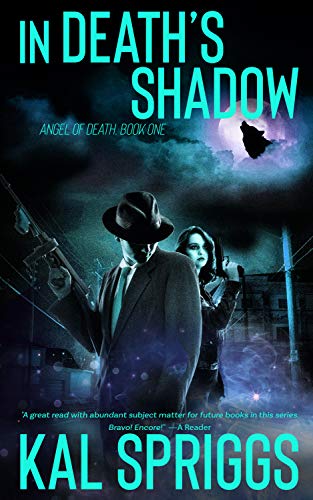
Review: in Death's Shadow

This is one of those books where I cannot tell you how it came to my consciousness. 


I recall getting a review copy. For all I know, Kal could have mentioned asking for reviewers in one of our groups and I just volunteered.

However I am glad that I got a chance to get this particular review copy, though I cannot tell you for the life of me how it came into my possession. 

This book has so many fun entertaining elements to it, it is hard to know where exactly to begin.

  • You have Metallurgy on bullets that I have not seen since the first Monster Hunter novel. 
  • It brings in Creative elements that would make Jim Butcher want to take notes. 
  • And frankly I also believe that there is a Quantum Leap reference just thrown in for good measure. (When you have a entity that no one else can see except our protagonist and he is called Sam I try to remember back to Quantum Leap to remember which character was played by Dean Stockwell — Al or Sam.)

Welcome to In Death's Shadow.
Ari lives in the shadow of death.
Ari is a combat veteran who has chosen to leave the military behind and live a quiet, normal life.  He's got a few problems though.  For one thing, the cops think he's a serial killer.  For another, a vengeful politician has put Ari in his crosshairs.  To make matters worse, Ari has a guardian angel... and not just any angel, Ari's protector is the Angel of Death.  When his life is in danger, people start to die, and Ari's guardian can sometimes be indiscriminate whose life he takes when protecting him.

That's not even the worst problem.  Death wasn't assigned to him by mistake.  An ancient werewolf wants Ari dead and even with death on his side, Ari might not survive.

Ari needs to find a way to stay alive, to clear his name, and most importantly to get out from under the shadow of death and live a normal life... even if it kills him.
Yes, a reaper playing guardian angel. I appreciate how Kal has avoided making our hero utterly indestructible by giving him a guardian angel who is akin to a weapon of mass destruction. 

Also appreciated? The execution and showing us the point of view of how at this reaper operated within his rules and regulations. 

Overall the book is so much fun I didn't put it down from the moment I picked it up. Right now I am only waiting for book two to come out (and I suspect book 3) so I can just buy all of them in hardcopy and spread them among my friends and family.

Kal brings a lot of wonderful little touches to his writing style. He has one of the better opening lines I've seen since "the building was on fire and it was not my fault." The very off-hand casual easy descriptions and backstory feels effortless -- largely executed with nice sharp background notes that leave a nice little sting and then move on with the rest of the story, easily throwing them out... But boy, does the reader feel them. 

There is also a lot of very easy humor such as how Sam (our Guardian Reaper) chooses to protect our hero. Sometimes to laughable degree — that though Kal never resorts to a Rube Goldberg mechanic. In terms of little touches, there are lines like "I'd managed to avoid ruining this set of clothing with blood at least." 

As I said, it's the little things.

Due to the nature of the Guardian reaper, Sam's protection has led to him having more than a few run-ins with the police. 

Kal even manages to have to make use of the old canard 
"Do you have plans for the day?" "No, I can't make plans, then they can throw around words like premeditation." 
I've been waiting for someone to use that in a novel for years. He just slid it in like a nice stiletto and moved on.

And no, even though Sam is very thorough about his job, he never turns into a deus ex machina. Never. That's freaking impressive.

I even like the little bit about how Sam really enjoys he 24 hour news cycle as "like an athlete staying up on sports news". Also, Sam's commentary on CNN is beautiful.

Great one liners include
"Are demons common in Detroit?" "Clearly you haven't been to Detroit lately." 
"Angels are the police of the Supernatural world" "What does that make Sam?" "Designed sniper."
There are several elements that almost feel like nods to other genre novels. For example one could be forgiven for thinking that Harry dresden's werewolf / Terminator scene is slipped in this one, or having supernatural beasties encountered in Afghanistan feels a little bit like Monster Hunter. And again, little touches like casually mentioning a werewolf and "how thermite grenades work wonders." 

As I said above, some of the metallurgy is so good, I intend to steal a lot of it. Including silver and mercury arounds, as well as electrum.

We have great action, dark humor, easily executed backstory that is all relevant to the plot, along with some great world-building at a pace Mickey Spillane would have loved.

I will also admit to highly enjoying Kal's version of werewolf mythology and lore. He does some nice variations that I personally have never seen before. And he comes up with perfect reasons and rationale for werewolves to be 100% pure evil all the time. After all, one of the enemies is literally a soul sucking werewolf from Hell.

And these are some of the lesser problems our hero will have to deal with. Because on top of a wonderful first novel, Kal has effortlessly set up a sequel without any actual sequel baiting. There is no Empire Strikes Back level BS. There is no "to be continued." And there is only an ending that would have worked perfectly well with the final line of a comic book movie. I mean a good one.

Spriggs is such a good author that it was nearly halfway through the book before I realized how many tropes and cliches that Kal had made good use of without them feeling at all like cliches or tropes. Including: a dead fiance, memory loss before a certain age, et al. However it feels more like the sort of mash up that brought us something as brilliant as Jim butcher's Codex Alera novels. 

At the end, we even get a little of the "hero of the borrowed heart."

Anyway, 5/5. This book was excellent. I look forward to the next one. Hopefully, it comes out soon.

Thursday, March 26, 2020

Review: Psycho (and Psychic) Games

I've already reviewed Amie Gibbons' Psychic Undercover (with the Undead), a law enforcement UF novel that really makes Laurell K. Hamilton look like an amateur (okay, LKH does guns better, but since LKH has even managed to make Edward a useless character, I'm not feeling charitable).

And now, we have Psycho (and Psychic) Games (The SDF Paranormal Mysteries Book 2)

Psycho (and Psychic) Games is ... 

Well, let's just say this is what happens when southerners make a Hannibal Lecter.


And they thought catching the serial killer was difficult...

Psychic Ariana Ryder just completed her probationary year and is now a full agent in the FBI's Special Division Force, a semi-secret branch that investigates paranormal crimes. She's got a great, if strict and strictly yummy, boss, a vampire for a boyfriend, and yeah, that has its issues and politics, but overall, life's lookin' pretty good.

The director, in a bid to score political points, puts Ariana on interrogating famous serial killer JB Truck, aka The Puzzle Master. Truck's been in prison two years and the authorities still can't figure out who all his victims were or where his vast resources came from.

Ariana's mission is simple, get visions off the psycho until they get the information they need.

But nothing's ever simple when there's magic afoot. The vampire queen's gunning for Ariana, there's a mysterious new shifter in town who needs a psychic's help (and is way too flirty considerin' she's a lady with a boyfriend), and Truck's got a few tricks of his own.

And he didn't end up in Nashville by chance.

Frankly, this book already has a very nice summation of the novel.
"This isn't Silence of the Lambs, it's freaking Nightmare on Elm Street."
I think this sums it up nicely.

I would say that this is as good as the first novel, though there are some minor issues. You don't "sick people" on others. There were one or two moments where I was concerned we were going to enter into squicky Anita Blake BS. Don't worry: while the sex did get heavier into detail, it's still better (and easier to skip) than the Hamilton books. In fact, it's more like how I with Hamilton would write her books. Maybe I could get back into them.

But as I said, this was is just as good as Gibbons' first novel in the series. It has elements of fantasy microbiology (which was my favorite parts of Grimm, and I would like to see more of that in fantasy in the genre in general).

And Gibbons' does some cute bits of business with the psychopath du jour. There was a good deal of 3D chess going on that reminded me of the Joker. And then he turns into Deadpool (from before he became a popular character)

This one even solved a lot of my problems with the first one. Because this was the book where our heroine is a full agent, and it was time for her to just grow the hell up.

And then she ends by setting up book three.

I've only got one noticeable problem with the series in general so far and this individual book in particular.

With the book, it's a bit unbalanced. About 75% deals with the serial killer. Then we have a break and we switch tracks, where it turns into a relatively good variation on an Anita Blake novel (a bit of soap opera, a touch of melodrama, and let's talk about feelings -- though that was in service of actually FURTHERING THE PLOT, so it gets a pass).

With the series. I don't have a really good sense of place. This is something that is occasionally a problem with even Jim Butcher. I don't get a sense that this is Nashville. I like to get an idea of where the heck I am. But aside from some of the accents, this could be almost any city and state in the union.

To be perfectly honest, this is still a 5/5. The problems in the book are easily overlooked and forgiven. If I were being more nitpicky, I'd penalize the overall score. But I'm not. And the book was still enjoyable.

So if you're interested into a nice mystery, something that harkens back to the days before Anita Blake before it became Penthouse letters, you're going to want to read this one.